
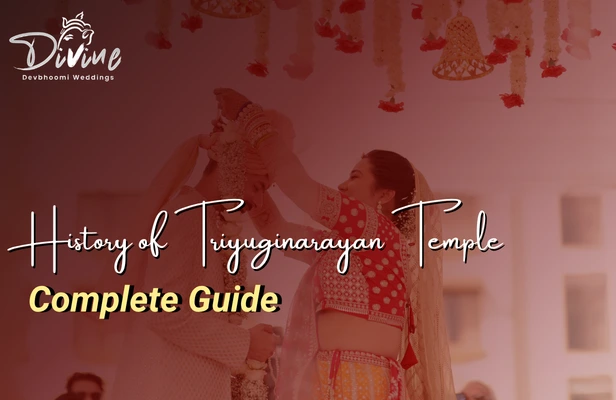
Imagine standing in a quiet Himalayan village just before sunrise. Mist curls around the pine trees, temple bells echo softly through the mountains, and in front of you burns a small, steady fire that has not gone out for centuries. According to Hindu belief, this is the very fire that once lit the wedding of Lord Shiva and Goddess Parvati, the divine couple whose union is celebrated across India even today.
This is Triyuginarayan Temple, tucked away in the Rudraprayag district of Uttarakhand, not far from the Kedarnath route. The History of Triyuginarayan Temple is not just the story of stone walls and an ancient sanctum. It is the story of faith passed down through generations, of a sacred flame that pilgrims still walk around during their own weddings, and of a small Himalayan shrine that has quietly become one of the most meaningful destination wedding venues in the country.
Historians study it for its architecture. Pilgrims visit it for blessings. Couples travel here to be married in front of the same fire that, tradition says, witnessed the wedding of the gods. In this guide, we bring together mythology, history, architecture, and practical travel details so you understand not only why this temple is famous, but why it continues to matter to so many people, centuries after it was first built.
The name Triyuginarayan comes from two Sanskrit words: 'Tri Yug', meaning three ages or epochs, and 'Narayan', another name for Lord Vishnu. Together, the name suggests that this Narayan temple has existed and been worshipped across three yugas, or cosmic ages, making it one of the oldest continuously revered sites in the Himalayan region.
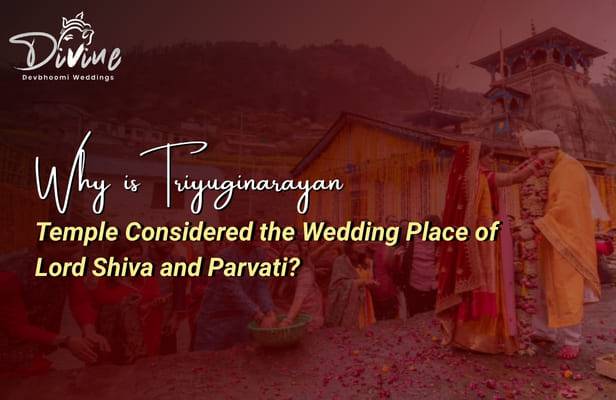
According to Hindu tradition, this is the exact spot where Lord Shiva and Goddess Parvati were married, with Lord Vishnu himself presiding over the ceremony as Parvati's brother. Local legend holds that the sacred fire lit for that wedding, known as the Akhand Dhuni, has burned without interruption ever since, through all three yugas that have passed.
References to the temple appear in regional Puranic traditions and Himalayan pilgrimage literature associated with the Kedarnath–Badrinath circuit, though, like many Himalayan shrines, much of its early history survives through oral tradition and scripture rather than dated inscriptions. What is clear is that Triyuginarayan has been treated as sacred ground for an extremely long time, standing quietly in the shadow of its more famous neighbour, Kedarnath.
Today, the History of Triyuginarayan Temple is inseparable from the Char Dham region of Uttarakhand. It sits along the traditional route to Kedarnath, and pilgrims heading to the higher Himalayas have, for generations, stopped here first to seek blessings at the site of the divine wedding before continuing their journey.
The story of Shiva and Parvati is one of the most loved tales in Hindu mythology. Parvati, daughter of the Himalayas, performed years of intense penance to win Lord Shiva as her husband. Moved by her devotion, Shiva finally agreed to marry her, and the wedding, according to legend, took place in this quiet Himalayan valley rather than in any grand city.
Lord Vishnu played a central role in the ceremony. With no brother of her own present to perform the rituals a bride's family traditionally carries out, Vishnu stepped in and acted as Parvati's brother, giving her away and conducting the sacred rites on her behalf. This is why the temple's presiding deity is Lord Vishnu, worshipped here as Triyuginarayan, even though the site is most famous for a story about Shiva and Parvati.
Tradition also holds that Lord Brahma, the creator, served as the priest for the wedding, chanting the mantras and guiding the ceremony, while other gods and celestial beings gathered nearby to witness the union. This is part of why devotees consider the site so powerful: it is remembered not as an ordinary wedding, but as a divine assembly, with the three major forces of Hindu cosmology, Brahma, Vishnu, and Shiva, all present together in one place.
For devotees, this story carries a deeper meaning. It represents the coming together of devotion and grace, and it explains why the temple has become so closely associated with marriage blessings, commitment, and the idea of a union sanctified before the gods themselves.
At the heart of the temple courtyard sits the Akhand Dhuni, a continuously burning fire that, according to belief, was first lit for the wedding of Shiva and Parvati and has never been extinguished since. Temple priests and local caretakers have tended it for generations, adding wood regularly to keep it alive.
For devotees, the flame is not just a religious symbol but living proof of the wedding itself. It is treated as a witness, the same way the fire, or Agni, is treated as a divine witness in every traditional Hindu wedding ceremony even today.
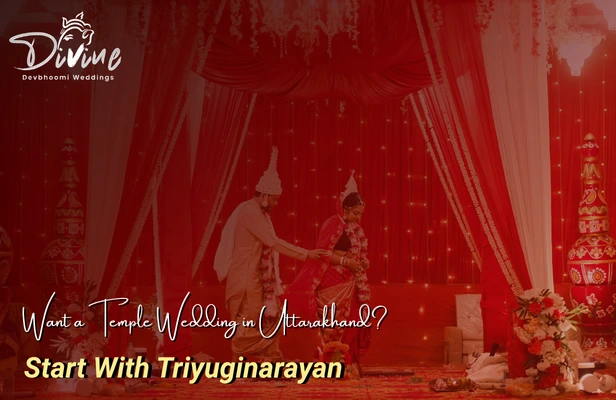
Visitors, especially those who are newly married, are encouraged to walk around this sacred fire, echoing the seven rounds, or saptapadi, that couples take around the fire during their own wedding rituals. Couples who marry at the temple perform their vows around this same flame, connecting their marriage symbolically to that of Shiva and Parvati.
Many pilgrims also collect a small amount of ash from the Akhand Dhuni before they leave. This sacred ash, known as vibhuti, is believed to carry blessings for a happy and lasting married life, and is often taken home and kept safely by newly married couples as a token of protection over their union.
From a practical standpoint, maintaining a fire for such a long, uninterrupted stretch of time in a remote Himalayan location is itself a remarkable feat of tradition and discipline, one that reflects the deep commitment of the priests and the local community to preserving this belief across generations.
There is no single, universally agreed-upon record naming the exact builder or the precise year of construction of Triyuginarayan Temple. Much of what is known comes down through regional tradition, temple lore, and comparisons with similar structures in the area, rather than a dated founding inscription.
Many local traditions connect the temple, at least in terms of restoration and prominence, to the broader wave of temple building and consolidation associated with Adi Shankaracharya, the eighth-century philosopher and reformer credited with reviving several major Himalayan shrines, including Kedarnath and Badrinath. Whether Shankaracharya personally established Triyuginarayan or simply helped restore and popularise an already ancient site is not settled with certainty, and readers should treat this connection as part of temple tradition rather than confirmed historical fact.
The temple's stone construction and its architectural similarities to Kedarnath suggest it belongs to the same broad family of medieval Himalayan temple building, even if the origins of worship at this specific spot go back much further in myth and memory.
Over the centuries, the temple has been preserved and maintained by local priests and the surrounding community, who have kept both the physical structure and the ritual of the eternal flame alive despite the challenges of a high-altitude, remote Himalayan location.
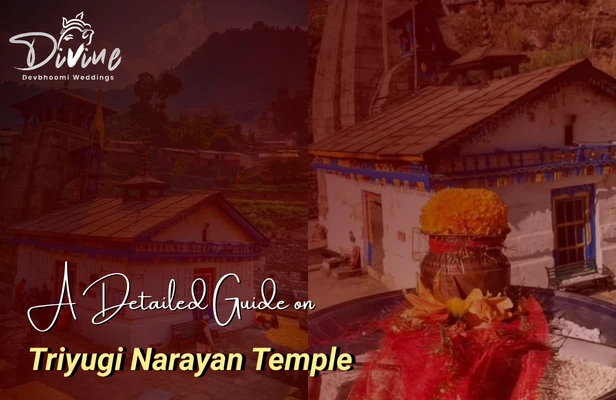
Triyuginarayan Temple is built in a simple yet dignified stone style typical of the Garhwal Himalayas. Its sloped roof, sturdy stone walls, and modest sanctum reflect a form of temple architecture designed to withstand heavy snow, rain, and the harsh mountain climate rather than to impress through scale or ornamentation.
Inside the sanctum sits an idol of Lord Vishnu, worshipped here in his Narayan form, flanked by smaller shrines and carvings that reflect centuries of ritual use. The courtyard in front of the main shrine houses the Akhand Dhuni, along with space for pilgrims and wedding parties to gather during ceremonies.
Ancient carvings on the temple walls, though weathered by time and altitude, still hint at the craftsmanship that went into the structure. The overall design bears a noticeable resemblance to the Kedarnath temple, both in its stone-block construction and its restrained, functional layout, which is one reason many historians group the two temples within the same regional architectural tradition.
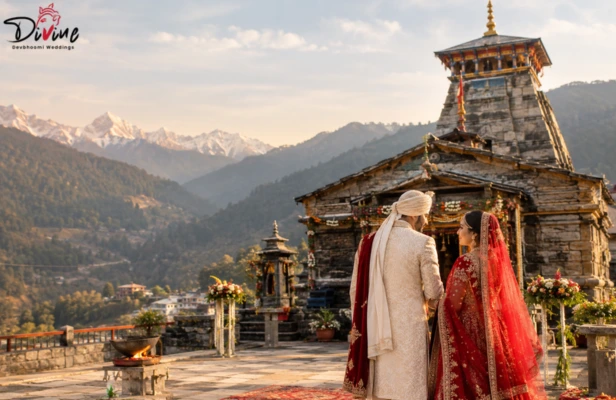
Surrounded by deodar and pine forests, with the Himalayan peaks rising in the background, the temple's setting adds to its atmosphere. Unlike temples built for grandeur in the plains, Triyuginarayan feels intimate and unhurried, in keeping with its identity as a place of personal devotion rather than mass spectacle.
Triyuginarayan Temple's fame today rests on several overlapping identities. First and foremost, it is remembered as the site of the Shiva-Parvati wedding, which alone makes it significant to millions of Hindus who revere this divine couple.
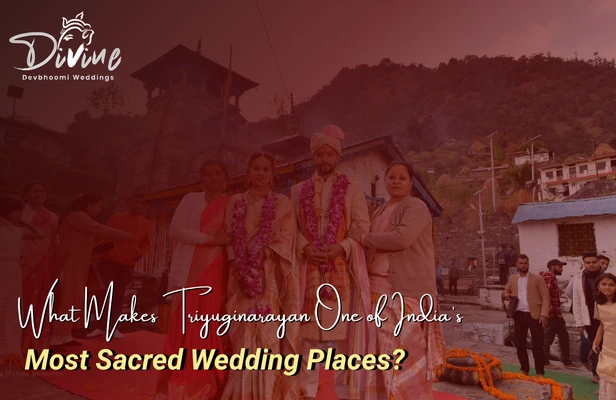
Second, it has become a genuine destination wedding location. Couples from across India, and increasingly from abroad, choose to hold their wedding ceremonies here specifically because of the temple's mythological association, seeking blessings that feel rooted in something far older and larger than themselves.
Third, it draws religious tourism as part of the wider Kedarnath pilgrimage circuit. Many pilgrims heading toward Kedarnath make a point of stopping at Triyuginarayan first, treating it as a spiritually meaningful prelude to the more physically demanding journey ahead.
Finally, the temple's peaceful Himalayan setting, framed by forested slopes and mountain air, has made it popular among photographers and travellers who are drawn less by mythology and more by the quiet, contemplative beauty of the location itself.
It helps to separate what is rooted in faith from what can be independently verified. The table below lays out both perspectives side by side.
|
Mythological Belief |
Historical Perspective |
|
Shiva-Parvati married here |
Supported mainly through Hindu scriptures, regional tradition, and continuous local belief |
|
Eternal Flame burning since the divine wedding |
A living religious tradition maintained by temple priests; its exact age is not independently dated |
|
Vishnu hosted the wedding as Parvati's brother |
A mythological narrative explaining why Vishnu, not Shiva, is the temple's presiding deity |
|
The temple is thousands of years old |
The existing stone structure reflects medieval Himalayan temple architecture, similar in style to Kedarnath |
None of this diminishes the temple's importance. Faith and recorded history often occupy different timelines, and Triyuginarayan is a good example of a site where devotion, not documentation, has kept a tradition alive for generations. Visitors are best served by appreciating both: the emotional and spiritual weight of the legend, and the more measured, evidence-based view of its architecture and age.
In Hinduism, Triyuginarayan holds a unique place because it brings together the worship of Vishnu and the legacy of Shiva and Parvati in a single site. Devotees consider a visit here especially auspicious for seeking blessings related to marriage, family harmony, and long-lasting relationships.
The temple is closely tied to the wider network of sacred sites in the Kedarnath valley, and pilgrims often include it as part of their broader spiritual journey through the region. Its sacred ponds, discussed below, add another layer of ritual significance, offering pilgrims specific places to bathe or perform rites believed to have been used by the gods themselves before the wedding.
During certain festivals and the peak wedding season, the temple sees a noticeable rise in visitors, with many couples specifically timing their visit to coincide with auspicious dates for marriage as per the Hindu calendar.
Surrounding the temple are four sacred ponds, or kunds, each tied to a specific part of the wedding legend.
Rudra Kund is believed to be the spot where Lord Shiva performed his ritual bath before the wedding ceremony began.
Vishnu Kund is associated with Lord Vishnu, who is said to have bathed here before taking on his role as Parvati's brother during the rites.
Brahma Kund is linked to Lord Brahma, who bathed here before presiding over the ceremony as the officiating priest.
Saraswati Kund holds particular significance, as tradition holds that the river Saraswati flows through it, and its water is used in the temple's daily rituals as well as in wedding ceremonies performed on site.
Pilgrims often visit these kunds in sequence, treating each one as a small ritual stop that deepens their connection to the larger story before they enter the main temple.
Read More - How Much Does Triyuginarayan Temple Wedding Cost 2026?
Summer, from roughly April to June, is one of the most comfortable times to visit, with pleasant daytime temperatures and clear mountain views, making it a popular window for both pilgrimage and wedding travel.
Monsoon, from July to September, brings heavy rain and a higher risk of landslides on the mountain roads leading up to the temple, so travellers should check road conditions carefully before setting out during these months.
Autumn, from October to November, offers crisp, clear weather and is considered one of the best times to visit for both sightseeing and photography, as the skies tend to be clearer after the monsoon.
Winter, from December to March, brings cold temperatures and occasional snowfall, which some visitors find atmospheric, though warm clothing and caution on the roads are essential during this period.
For couples specifically planning a wedding here, it's worth noting that the temple sees its heaviest wedding-season footfall around the same auspicious periods used across North India for Hindu marriages, so early planning and advance coordination with local priests is recommended.
The nearest airport is Jolly Grant Airport in Dehradun, which is well connected to major Indian cities and serves as the typical starting point for most pilgrims and travellers heading into this part of Uttarakhand.
The nearest major railway station is Rishikesh, which connects to the broader Indian rail network and is often the first stop for pilgrims travelling by train before continuing by road.
By road, the temple is reached via Sonprayag, from where a short drive leads to Triyuginarayan village. The route generally passes through Rudraprayag, a key junction town on the way to the Kedarnath valley.
The temple is roughly a short distance from Sonprayag, making it an easy and popular stop for those already travelling toward Kedarnath, and a moderate drive from Rudraprayag along the same mountain route.
For those coming from Rishikesh, the journey typically takes the better part of a day by road, given the winding mountain roads, so most travellers plan an overnight halt along the way rather than attempting the full journey in one stretch.
Parking is available near the village, though space can be limited during peak pilgrimage and wedding season, and the final stretch to the temple itself is usually covered on foot through the village lanes.
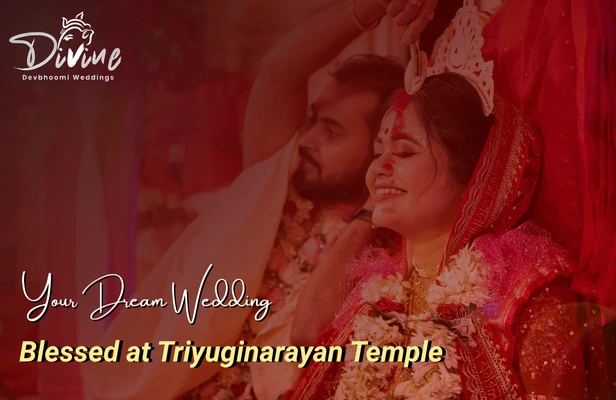
For many couples, marrying here is about more than convenience or scenery. It is about connecting their own union to a story that Hindu tradition treats as the original template for marriage itself, the wedding of Shiva and Parvati.
The presence of the Akhand Dhuni adds a powerful symbolic layer to the ceremony. Taking wedding rounds around a fire believed to have burned since a divine wedding feels, for many, more meaningful than doing so around an ordinary ceremonial flame.
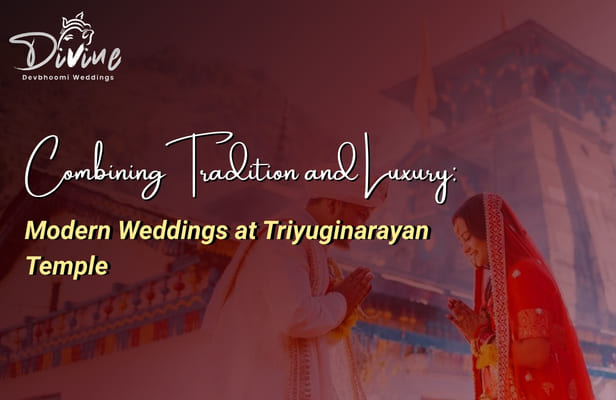
The temple's remote, peaceful setting also appeals to couples looking for an intimate destination wedding away from the noise of city venues, while still keeping the ceremony rooted in traditional Hindu ritual.
As word of the temple's significance has spread, particularly through travel media and religious tourism promotion in Uttarakhand, more couples each year are choosing Triyuginarayan not as a novelty, but as a deliberate, spiritually grounded choice for one of the most important days of their lives.
The History of Triyuginarayan Temple is, at its heart, a story about permanence, a fire that has never gone out, a devotion that has never faded, and a legend that continues to shape how people understand marriage itself. It is not simply an ancient monument tucked into the Garhwal Himalayas; it is a living tradition that families, priests, and couples have kept alive for generations.
Whether you arrive as a pilgrim seeking blessings, a historian curious about its architecture and origins, or a couple hoping to be married before the same sacred fire that is said to have witnessed the wedding of Shiva and Parvati, Triyuginarayan leaves visitors with something rare: a sense of standing at the meeting point of myth, history, and personal faith. Few Himalayan temples offer that combination quite so quietly, or quite so powerfully.
What is the history of Triyuginarayan Temple?
The temple is traditionally believed to mark the site where Lord Shiva and Goddess Parvati were married, with Lord Vishnu presiding as Parvati's brother. Its existing stone structure reflects medieval Himalayan temple architecture, while the wedding story itself comes from long-standing Hindu scripture and tradition.
Why is Triyuginarayan Temple famous?
It is famous both as the mythological site of the Shiva-Parvati wedding and as a popular destination for couples to marry today in front of its continuously burning sacred fire.
Where is Triyuginarayan Temple located?
The temple is located in the Rudraprayag district of Uttarakhand, along the traditional pilgrimage route to Kedarnath, near Sonprayag.
Who built Triyuginarayan Temple?
There is no single confirmed record of who built the temple. Local tradition often links its restoration and prominence to the era of Adi Shankaracharya, though this is based on regional belief rather than a dated inscription.
Why did Lord Shiva and Goddess Parvati marry at Triyuginarayan Temple?
Hindu tradition holds that this Himalayan spot was chosen for their wedding, with Lord Vishnu acting as Parvati's brother and Lord Brahma serving as the officiating priest.
What is the significance of the eternal flame at Triyuginarayan Temple?
The Akhand Dhuni is believed to have been lit for the original wedding of Shiva and Parvati and has been kept burning ever since, serving as a witness for couples who marry at the temple today.
How old is Triyuginarayan Temple?
There is no universally agreed date of construction. Its architecture places it within the medieval period of Himalayan temple building, while its mythological origins are said to stretch back much further.
Is Triyuginarayan Temple older than Kedarnath Temple?
This is difficult to state with certainty, as neither temple has a precisely documented founding date; both are closely linked in tradition and architectural style.
Which god is worshipped in Triyuginarayan Temple?
Lord Vishnu, in his Narayan form, is the presiding deity, even though the temple is most widely known for the Shiva-Parvati wedding legend.
Can couples get married at Triyuginarayan Temple today?
Yes, couples regularly travel here to marry in front of the Akhand Dhuni, with local priests assisting in conducting the ceremony and completing the required documentation.
What is the best time to visit Triyuginarayan Temple?
Summer and autumn generally offer the most comfortable weather and clearest mountain views, while monsoon months carry a higher risk of landslides on the approach roads.
How far is Triyuginarayan Temple from Kedarnath?
The temple lies along the same route travellers use to reach Kedarnath, making it a natural stop for pilgrims before they continue further into the mountains toward Kedarnath.
What are the sacred kunds at Triyuginarayan Temple?
The four kunds are Rudra Kund, Vishnu Kund, Brahma Kund, and Saraswati Kund, each tied to a different figure associated with the wedding legend.
Is Triyuginarayan Temple open throughout the year?
The temple generally remains accessible through the year, though winter snowfall and monsoon landslides can affect road conditions on the approach.
What are the timings of Triyuginarayan Temple?
The temple typically follows standard daily darshan hours common to Himalayan shrines in the region; visitors are advised to confirm current timings locally before planning their visit.
How do I reach Triyuginarayan Temple from Rishikesh or Dehradun?
Travellers usually fly or take the train into Dehradun or Rishikesh, then continue by road via Rudraprayag and Sonprayag to reach the temple.
What makes Triyuginarayan Temple unique among Hindu temples?
Its combination of a continuously burning sacred fire, its direct link to the Shiva-Parvati wedding legend, and its ongoing role as an active wedding venue sets it apart from most other Himalayan temples.
Is online booking available for weddings at Triyuginarayan Temple?
Couples typically coordinate directly with local temple priests or authorised wedding planners in the area to arrange ceremonies, rather than through a centralised online booking system.
Why do devotees collect ash from the Akhand Dhuni?
The ash is considered a blessing linked to the sacred fire of the divine wedding, and is often kept by newly married couples as a symbol of protection over their marriage.
What are the nearby places to visit around Triyuginarayan Temple?
Sonprayag, Rudraprayag, and the wider Kedarnath pilgrimage route are commonly visited alongside Triyuginarayan, allowing travellers to combine several sacred sites in one journey.














































































From pre-wedding celebrations to grand wedding days, we provide end-to-end services for all functions.
Copyright © 2024 | All Rights reserved by Divine Dev Bhoomi | Designed & Developed by Edtech Innovate Pvt. Ltd.