
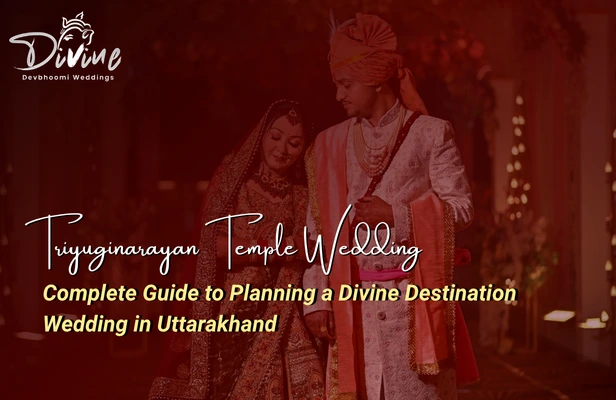
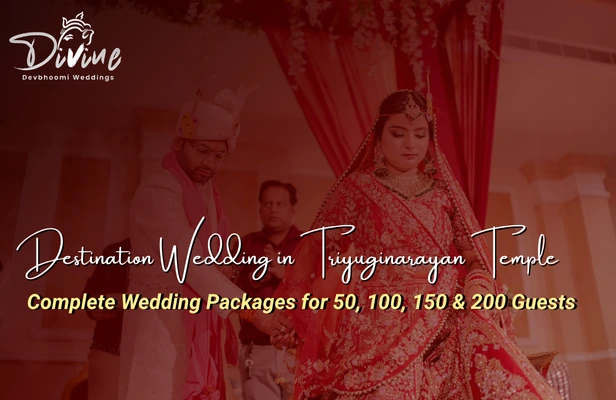
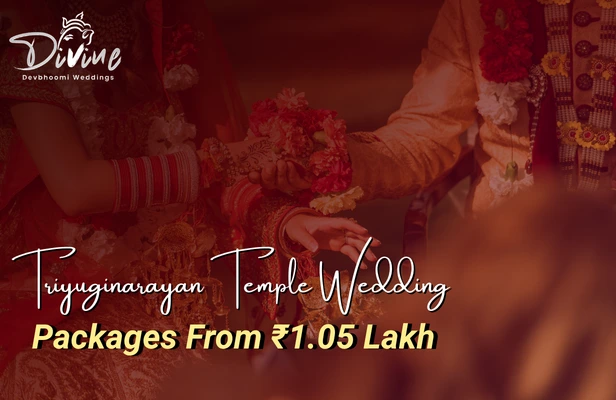
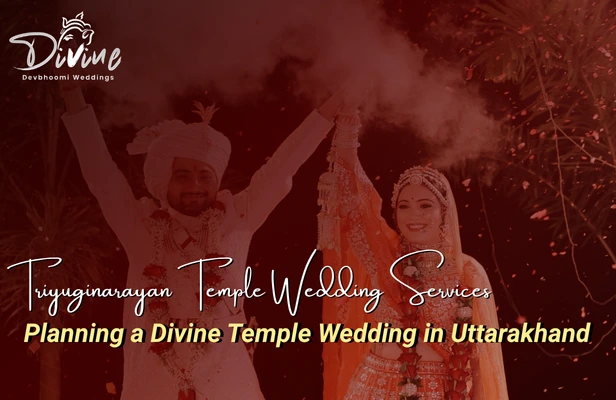
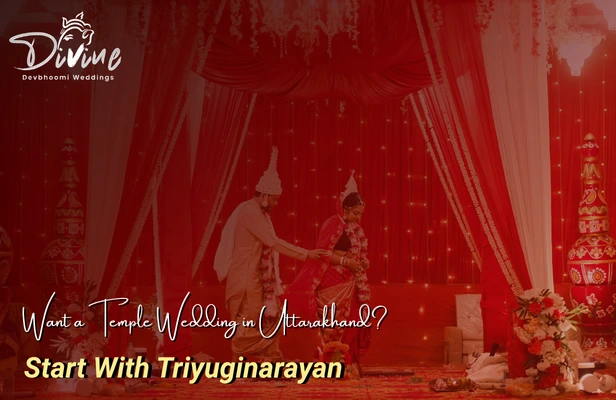
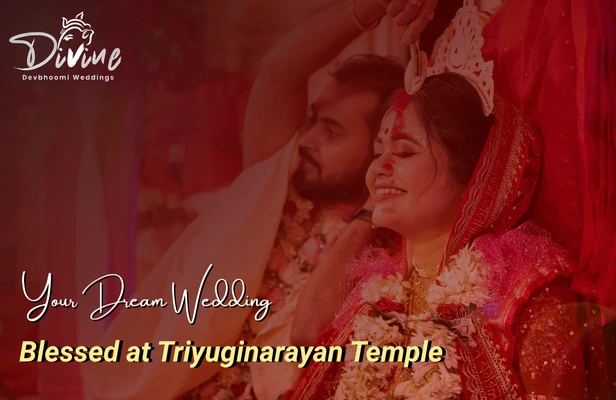
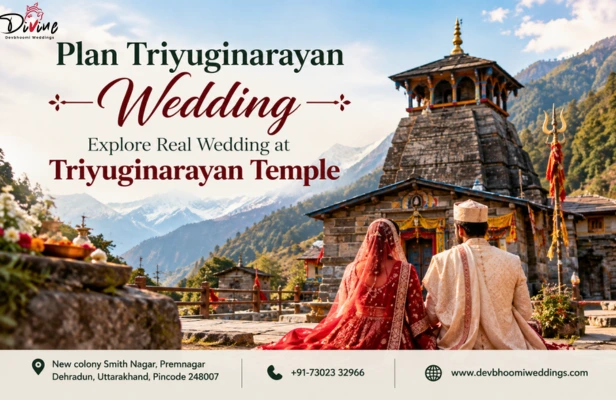
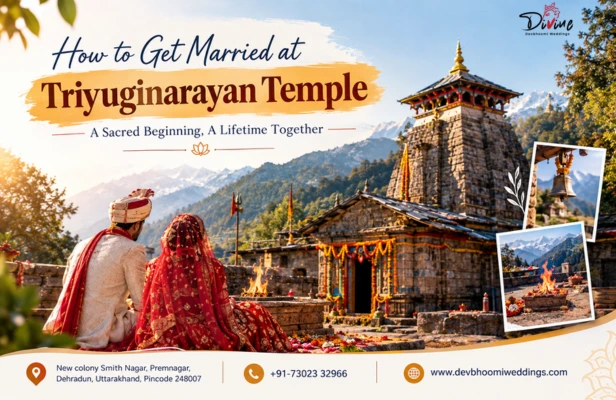
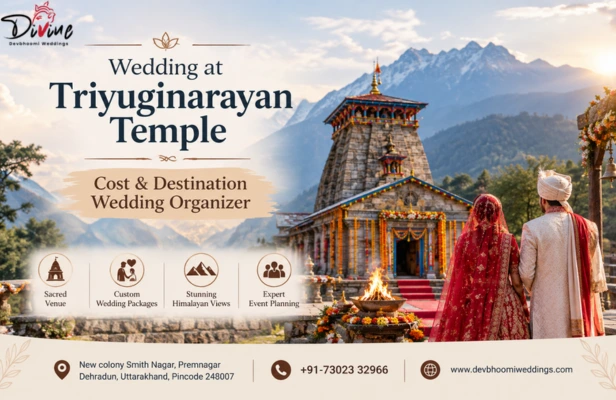
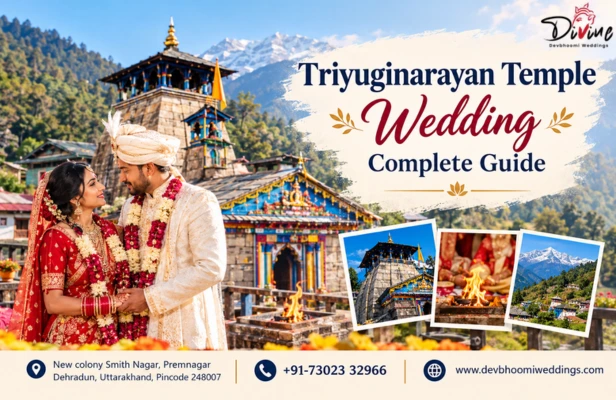
A Triyuginarayan Temple wedding is a Hindu marriage ceremony performed at the ancient temple in Uttarakhand where, according to legend, Lord Shiva and Goddess Parvati themselves got married beside an eternal sacred fire. Couples choose it for its spiritual authenticity, Himalayan setting, and intimate scale. It suits Hindu families, NRI couples, and spiritual travellers who want a meaningful, tradition-rich wedding away from crowded banquet halls.
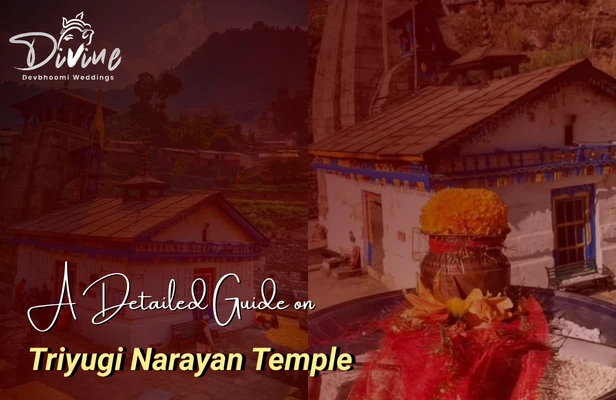
Destination weddings have moved past beaches and palaces. A growing number of Indian and NRI couples are now choosing spiritual destinations where faith, heritage, and nature come together — and few places match the significance of a Triyuginarayan Temple wedding. Tucked away in the Garhwal Himalayas of Uttarakhand, this centuries-old temple is regarded as the holiest wedding venue in Hindu tradition, believed to be the exact spot where Shiva and Parvati were married in the presence of Lord Vishnu and Brahma.
Uttarakhand itself is known as Devbhoomi, the "Land of the Gods," and Triyuginarayan sits comfortably among its most sacred sites, not far from the Kedarnath route. For couples who want more than a photogenic backdrop — who want their vows exchanged in a place with genuine mythological weight — this temple offers something no five-star resort can replicate.
This guide covers everything you need before saying "yes" to a Triyuginarayan wedding: the mythology behind it, step-by-step planning, realistic costs, rituals, accommodation, travel logistics, required documents, and answers to the questions couples ask most.
Long before it became a destination wedding trend, Triyuginarayan was already central to Hindu mythology. The temple's name itself translates roughly to "across three ages" (Tri-Yuga), referring to the belief that the divine wedding fire has burned continuously since the marriage of Shiva and Parvati.
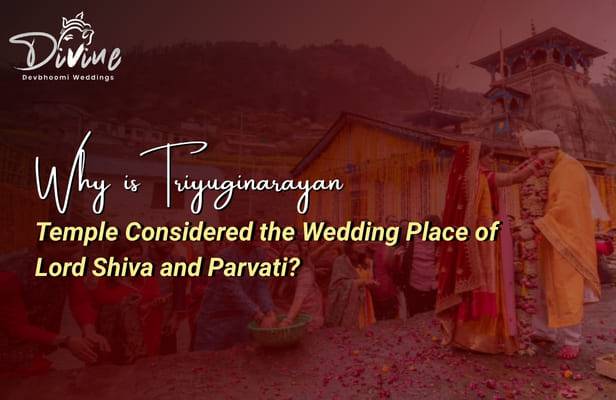
According to Puranic tradition, this is where Parvati's long penance to win Shiva as her husband finally succeeded. Vishnu is said to have acted as Parvati's brother and performed the Kanyadaan, while Brahma presided as the priest. The wedding fire lit for the ceremony has, according to local belief, never been extinguished.
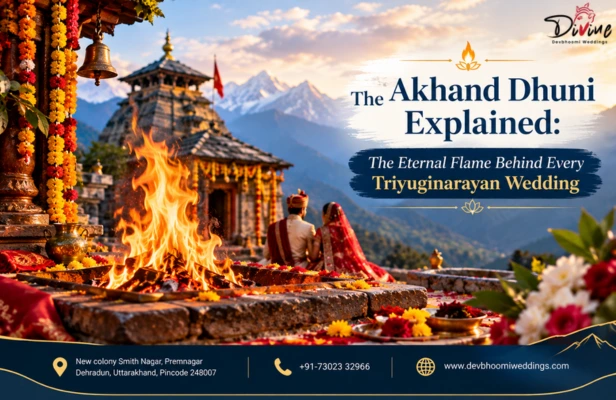
This continuously burning fire, known as the Akhand Dhuni, is the heart of the temple and the single biggest reason couples travel here. Devotees believe that circling this fire during their own wedding — rather than a temporary ceremonial one — connects their marriage directly to the union of Shiva and Parvati.
The temple is mentioned in ancient scriptures and has been a pilgrimage stop for centuries, particularly for travellers heading toward Kedarnath. Ash from the eternal fire is traditionally considered auspicious, and many couples take a pinch home as a blessing for their married life.
Read More - Best Triyuginarayan Temple Wedding Resort
Beyond mythology, there are practical and emotional reasons this venue keeps gaining popularity among couples planning a genuine spiritual destination wedding.
| Factor | Triyuginarayan Temple Wedding | Conventional Destination Wedding |
|---|---|---|
| Spiritual Significance | Extremely high — mythological wedding site | Usually none |
| Setting | Himalayan temple town, natural beauty | Resort, banquet hall, or beach |
| Guest Capacity | Small to medium, intimate | Can range from small to very large |
| Décor Requirement | Minimal — architecture does the work | Heavy décor budget usually needed |
| Rituals | Authentic, temple-led Vedic ceremony | Often customised or simplified |
| Accessibility | Moderate trek/drive required | Usually easy road/air access |
| Cost Structure | Generally lower for core ceremony | Often higher due to venue rental |
Planning a temple wedding is different from booking a banquet hall. Here is the realistic step-by-step process couples follow.
Most local planners in the region offer tiered packages. Inclusions vary, so always request an itemised quote.
| Package | Typical Inclusions | Best For |
|---|---|---|
| Budget Package | Temple rituals, basic accommodation, local transport | Couples wanting a simple, low-cost ceremony |
| Standard Package | Rituals, mid-range hotel stay, catering for small group, basic photography | Couples with 20–40 guests |
| Premium Package | Rituals, better accommodation, professional photography/videography, décor | Couples wanting a well-documented, comfortable experience |
| Luxury Package | Full-service planning, premium stays, drone coverage, guest hospitality management | Couples wanting a fully managed, high-end experience |
Most packages can be customised — swap in additional pre-wedding functions, extend guest stay, or add specific rituals based on family tradition.
There is no single fixed price for a Triyuginarayan wedding — costs vary widely based on guest count, season, and service level. Instead of quoting unverified numbers, here are the factors that actually move your budget:
As a general rule, a simple, intimate Triyuginarayan wedding tends to cost significantly less than a conventional resort destination wedding, largely because the venue itself needs little to no decoration. Always request a written, itemised quote from your planner rather than relying on a flat "package price."
The ceremony follows traditional Vedic structure, rooted in the same rituals believed to have been performed for Shiva and Parvati.
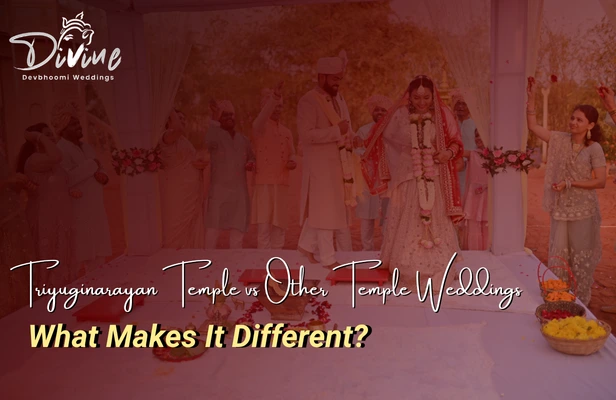
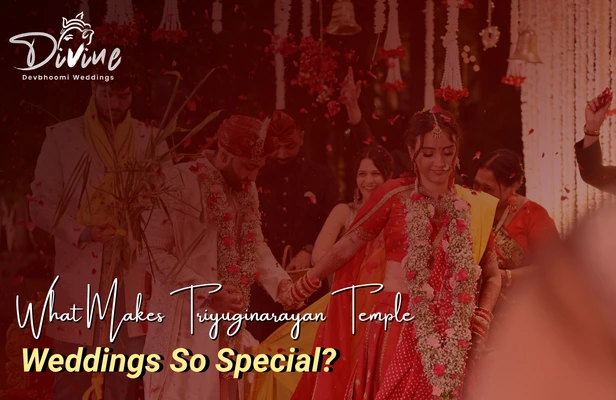
What makes this different from a typical mandap wedding is simple: couples circle the same fire believed to have witnessed the original divine marriage, rather than one lit specifically for their event.
The temple itself sits in a small village, so most guests stay in nearby towns and commute in for the ceremony.
| Budget Level | Options | Location |
|---|---|---|
| Budget | Basic guesthouses, dharamshalas | Triyuginarayan village, Sonprayag |
| Mid-Range | Standard hotels, homestays | Sonprayag, Guptkashi |
| Premium | Better-appointed hotels and resorts | Guptkashi, Rudraprayag |
| Group Stays | Multi-room guesthouses, group bookings | Sonprayag and surrounding villages |
Book at least a few months in advance, since rooms fill quickly during wedding season and Kedarnath yatra season, both of which draw heavy footfall to the same route.
| Season | Weather | Accessibility | Photography |
|---|---|---|---|
| Spring (March–May) | Pleasant, cool mornings | Good, roads clear | Excellent — clear mountain views |
| Summer (June) | Warm days, cool evenings | Good, before monsoon onset | Good, occasional haze |
| Monsoon (July–Aug) | Heavy rain, landslide risk | Poor — routes can shut | Not recommended |
| Autumn (Sept–Nov) | Clear skies, cool | Excellent | Best time overall — crisp Himalayan views |
| Winter (Dec–Feb) | Cold, occasional snow | Limited, weather-dependent | Dramatic but logistically harder |
Most planners recommend autumn as the ideal window — the weather is stable, roads are open, and the mountain visibility is at its best for photography.
The nearest airport is Jolly Grant Airport in Dehradun, roughly 210–220 km away, connected by road through Rishikesh and Rudraprayag.
Rishikesh and Haridwar are the nearest major railheads, both well-connected to Delhi and other major cities.
From Rishikesh or Haridwar, the route runs via Rudraprayag and Sonprayag to Triyuginarayan. The final stretch from Sonprayag involves a short trek or local vehicle ride.
| From | Approx. Distance |
|---|---|
| Delhi | ~430–450 km |
| Haridwar | ~230–250 km |
| Rishikesh | ~210–220 km |
| Dehradun | ~210–220 km |
| Kedarnath (via route) | ~5 km from Sonprayag junction |
Given the remote location and limited on-ground infrastructure, most couples benefit from working with a planner who genuinely knows the region rather than a generic destination wedding company operating remotely.
A Triyuginarayan Temple wedding offers something increasingly rare: a marriage ceremony rooted in genuine mythology, set against the raw beauty of the Garhwal Himalayas, without needing elaborate staging to feel meaningful. It suits couples who value tradition and spirituality as much as aesthetics. With careful planning — early bookings, the right local support, and realistic expectations about mountain travel — a wedding at this ancient temple can become one of the most memorable and spiritually significant days of your life.
It is a Hindu wedding ceremony performed at the Triyuginarayan Temple in Uttarakhand, believed to be the site where Lord Shiva and Goddess Parvati were married beside an eternal sacred fire.
It is famous because Hindu mythology places the wedding of Shiva and Parvati here, and the sacred fire from that occasion is believed to still burn continuously.
Costs vary based on guest count, accommodation choices, and services booked. It's best to get an itemised quote from a local planner rather than rely on fixed advertised prices.
Yes, NRI couples can marry at the temple, but they should carry valid passports and additional documentation, and complete marriage registration through appropriate legal channels afterward.
At least 6–12 months in advance is recommended, especially for dates during peak wedding season and autumn months.
No, temple rituals alone are not equivalent to legal marriage registration. Couples must register separately through local authorities.
Small pre-wedding functions can often be arranged at nearby accommodation properties, subject to space and local permissions.
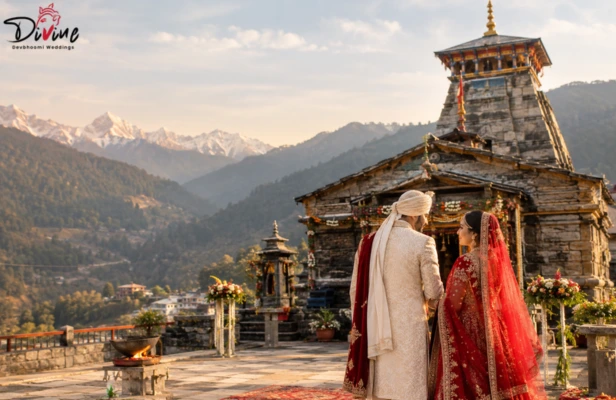
Given the temple's natural stone architecture and mountain backdrop, minimal floral and traditional décor typically works best rather than elaborate setups.
Photography is generally allowed in designated areas, but couples should confirm specific rules with temple authorities beforehand.
Jolly Grant Airport in Dehradun is the nearest airport, roughly 210–220 km away.

































From pre-wedding celebrations to grand wedding days, we provide end-to-end services for all functions.
Copyright © 2024 | All Rights reserved by Divine Dev Bhoomi | Designed & Developed by Edtech Innovate Pvt. Ltd.