

You should book a Triyuginarayan temple wedding 6 to 9 months in advance for peak season (April to June and September to November), and at least 3 to 4 months in advance for off-season dates. The absolute minimum is about 45 to 60 days, but this is risky because the temple is in a remote mountain village, the number of wedding slots is limited, and you also need time for permissions, priests, travel, and stay.
Short answer : "Book your Triyuginarayan temple wedding at least 6 months before your wedding date for peak season, and 3 months before for off-season."
These short answers are written for phone and smart-speaker searches.
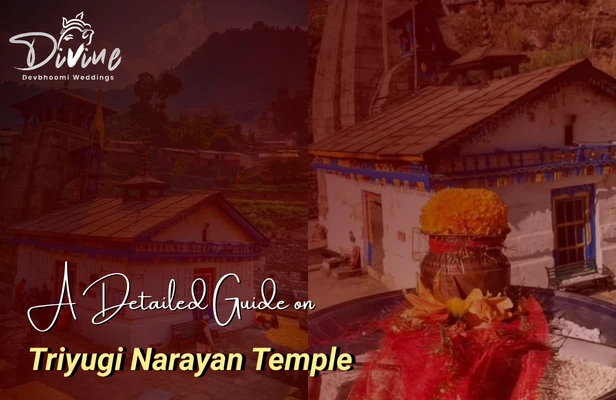
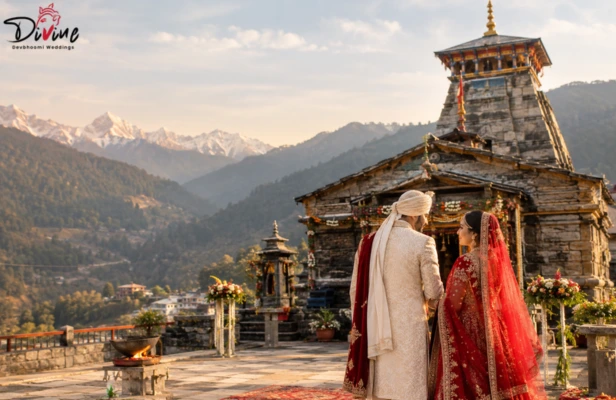
Triyuginarayan Temple is a small, ancient temple in Triyuginarayan village, Rudraprayag district, Uttarakhand. It sits in the Garhwal Himalayas, at an altitude of roughly 1,980 metres (about 6,500 feet).
According to Hindu belief, this is the very place where Lord Shiva and Goddess Parvati got married. Lord Vishnu is believed to have attended as Parvati's brother, and Lord Brahma is believed to have performed the ritual as the priest. The name itself comes from three words: Tri (three), Yugi (era), and Narayan (Lord Vishnu).
The most special part? An eternal sacred fire (Akhand Dhuni) burns in front of the temple. People believe it has been burning since the divine wedding, for three yugas. Couples who take their wedding vows around this fire feel their marriage is blessed by Shiva and Parvati themselves.
In recent years, the Uttarakhand government and local tourism groups have actively promoted the temple as a destination wedding spot. Many couples across India, and also NRIs, now want to marry here. This means demand is growing, and booking early has become more important than ever in 2026.
Before we go to the exact timeline, let us understand why you cannot plan this wedding in just a few weeks.
Here is a simple table to understand the ideal timeline.
|
Wedding Season |
Best Months |
Recommended Booking Time |
Minimum Booking Time |
|
Peak Season |
April, May, June |
8 to 9 months before |
4 to 5 months |
|
Second Peak Season |
September, October, November |
6 to 8 months before |
3 to 4 months |
|
Auspicious Wedding Dates (Muhurat) in any month |
Varies |
9 to 12 months before |
6 months |
|
Off-Season (Cold or Rainy) |
December to February, July to August |
3 to 4 months before |
45 to 60 days |
Important: These timelines are based on common wedding-planning practice for remote Himalayan destinations. Rules and slot availability can change, so always confirm with the temple committee, local administration, or your wedding planner.
Below is a complete plan. Follow it from the day you decide on Triyuginarayan until the wedding day.
Start by choosing a month. Check the Hindu panchang for auspicious dates (shubh muhurat) for 2026. Choose 2 or 3 backup dates, because your first choice may not be available.
Tip: Weekday weddings are often easier to arrange than weekend ones.
Because the temple is small and the area is remote, a smaller guest list works best. Many couples plan an intimate wedding with close family and friends. Decide your number early, as it affects everything: stay, food, transport, and permissions.
The temple falls under local temple management and Uttarakhand administration. Reach out to the official temple committee or the local authorities to ask:
Pro tip: Always get confirmation in writing (email, WhatsApp message, or letter) and keep a copy.
A priest who knows the Triyuginarayan wedding rituals is very important. Ask about the ritual list, samagri (puja items), time needed, and fees. Confirm the date and muhurat with the priest directly.
Stay options are usually in and around Triyuginarayan village, Guptkashi, Sonprayag, Phata, and Ukhimath. Many couples stay in Guptkashi or nearby towns because there are more rooms there. Book for yourself, the family, and guests. Take a few extra rooms in case of delays or weather changes.
The usual route is:
Book train tickets as soon as they open. Book flights early for better prices.
A temple wedding is a religious ceremony. For legal recognition in India, you should also register your marriage under the applicable law, such as the Hindu Marriage Act, 1955 or the Special Marriage Act, 1954. Keep these ready:
Note: Document rules differ for each state and case. Check with a local registrar or lawyer.
Carry-in equipment can be difficult in the mountains. Hire professionals who have shot weddings in hill locations. Ask about drone rules, as drones may need permission.
Choose between local Garhwali food, simple vegetarian meals, or catering brought from a nearby town. Because it is a temple wedding, pure vegetarian food is the usual and respectful choice.
Reconfirm the temple date, priest, hotel, transport, and vendors. Keep a weather backup plan. Check Uttarakhand road conditions and weather updates a week before travel.
Pack warm clothes, even in summer. Mountain evenings are cold. Carry medicines, power banks, comfortable shoes, rain protection, and printed copies of all documents.
Read More - Triyuginarayan Temple 2026: Complete Guide — Distance, Route & How to Reach from Sonprayag
The temple is generally open throughout the year, but the weather decides how comfortable your wedding will be.
|
Point |
Peak Season |
Off-Season |
|
Crowd |
High |
Low |
|
Prices |
Higher |
Lower |
|
Hotel availability |
Very limited |
Easier |
|
Weather |
Mostly good |
Rain or snow risk |
|
Book in advance |
6 to 9 months |
3 to 4 months |
|
Best for |
Larger family groups |
Small, quiet weddings |
There is no one fixed price, because costs depend on guests, stay, and services. Here are the main cost areas to budget for:
Money-saving tip: Book early. Early booking usually means better rates for hotels, flights, and cabs.
Start planning at least one year early if you want a peak-season date.
This wedding is perfect if you:
It may not be right if you:
For peak season (April to June and September to November), book 6 to 9 months in advance. For off-season dates, 3 to 4 months is a good time. The very minimum is about 45 to 60 days, but this may leave you with limited choices for dates, hotels, and priests. For auspicious muhurat dates, start even earlier, around 9 to 12 months.
The best months are April, May, June, September, October, and November. The weather is usually pleasant and roads are in better condition. Autumn (September to November) is often the most beautiful and comfortable choice, while summer is the most popular.
In general, couples who follow Hindu wedding traditions and meet the temple's and local administration's rules can marry here. Because rules can change, it is wise to confirm eligibility, documents, and permissions with the temple committee or local authorities before you finalise your plans.
The temple ceremony is a religious marriage. For legal proof, you should also register your marriage with the local marriage registrar under the Hindu Marriage Act, 1955 or the Special Marriage Act, 1954, as applicable. Marriage registration gives you an official marriage certificate, which is useful for passports, visas, banking, and insurance.
The temple area is small, so guest numbers are usually limited. A small gathering of close family and friends works best. Exact numbers can depend on temple rules and local administration decisions, so ask for the current limit in writing before inviting guests.
Common documents include ID proof (Aadhaar or passport), age proof, address proof, passport-size photos, and witness details. Some cases may need affidavits or a marriage invitation card. Requirements can vary, so check with the temple committee, your priest, and the local registrar.
The nearest major airport is Jolly Grant Airport, Dehradun. The nearest big railway stations are Haridwar and Rishikesh. From there, you travel by road via Rudraprayag and Guptkashi towards Sonprayag, and then to Triyuginarayan village. The road trip takes many hours, so plan rest stops and reach a day or two early.
The monsoon (July and August) is risky because of heavy rain, landslides, and road blockages in Uttarakhand. If you still choose this season, keep flexible dates, extra rooms, and travel insurance, and check weather and road updates before you leave. Most couples prefer other seasons.
The cost depends on your guest count, hotel type, travel, food, decoration, and photography. Temple rituals can be more affordable than a city wedding, but travel and stay add up, especially in peak season. Booking early often helps you get better rates. Always keep an extra 10 to 15 percent as emergency budget.
Carry wedding outfits, warm clothes, comfortable shoes, rain protection, medicines, ID proofs, printed documents, power banks, and puja items as advised by your priest. Mountain weather changes quickly, so even in summer you should pack for cold evenings.
|
Time Before Wedding |
What to Do |
|
9 to 12 months |
Choose season, check muhurat, set budget |
|
8 to 9 months |
Fix guest list, contact temple committee |
|
7 to 8 months |
Book priest and confirm date |
|
6 to 8 months |
Book hotels and rooms |
|
5 to 7 months |
Book trains, flights, and cabs |
|
4 to 6 months |
Prepare documents, book vendors |
|
3 to 4 months |
Plan food, outfits, and rituals |
|
1 to 2 months |
Reconfirm everything, prepare backup plan |
|
1 week |
Pack, check weather, print documents |
|
2 days before |
Reach the location and rest |
To plan a meaningful wedding here, it helps to understand the temple's story, its sacred spots, and why couples choose it. This also helps you explain the importance of the place to your family and guests.
Explore More - Small Wedding, Big Experience: The New Indian Wedding Trend
According to local belief and Puranic stories, Goddess Parvati was born as the daughter of Himavat, the king of the Himalayas. She did deep penance to marry Lord Shiva. Shiva finally accepted her, and the divine wedding took place at this very village. Lord Vishnu is said to have given Parvati's hand as her brother, and Lord Brahma is said to have performed the ritual as the priest.
This is why many couples believe that taking vows here brings the blessings of Shiva and Parvati, the ideal divine couple in Hindu tradition, for a strong, loving, and long-lasting marriage.
In front of the temple, a sacred fire burns continuously. Devotees believe it is the same fire that witnessed the divine wedding. Pilgrims offer wood (samidha) to this fire, and many keep a pinch of its ash as a blessing.
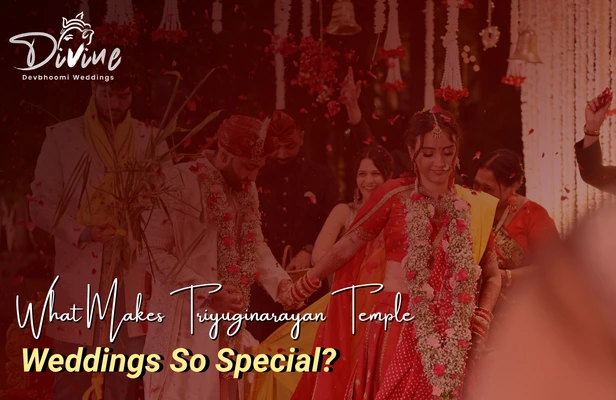
For a wedding, this fire is the heart of the ceremony. The couple takes the pheras (rounds) around it, and the vows are made in front of it.
Near the temple there are four holy kunds, each linked with a divine role in the wedding story:
|
Kund |
Common Belief |
|
Brahma Kund |
Linked with Lord Brahma, who is said to have performed the wedding rituals |
|
Vishnu Kund |
Linked with Lord Vishnu, believed to have performed the ritual bath |
|
Rudra Kund |
Linked with Lord Shiva (Rudra) |
|
Saraswati Kund |
Linked with the flow of holy water that supplies the other kunds |
Some visitors take a holy dip or sprinkle the water on themselves as a blessing. Always follow the local priest's guidance and the current temple rules.
Near the temple there is a sacred stone called Brahma Shila, which is believed to mark the exact spot of the divine wedding. Many couples visit it after the ceremony for blessings and photographs, if allowed.
Spiritual meaning: Marrying where Shiva and Parvati married feels deeply special.
The exact order of rituals can differ based on your family tradition, your priest, and the temple's current rules. The flow below is a general guide so you can discuss it with your pandit early.
|
Step |
Ritual |
What Happens |
|
1 |
Morning bath and dress |
Bride and groom get ready in traditional outfits |
|
2 |
Ganesh Puja |
Lord Ganesha is worshipped first for a smooth ceremony |
|
3 |
Kalash Sthapana |
A sacred pot is set up as a symbol of divine presence |
|
4 |
Sankalp |
The couple takes a resolve to start married life with dharma |
|
5 |
Jaimala (varmala) |
Garlands are exchanged |
|
6 |
Kanyadaan |
Bride's parents give their blessing and hand over the bride |
|
7 |
Havan |
Offerings are made into the sacred fire with mantras |
|
8 |
Pheras (Saptapadi) |
The couple walks around the sacred fire, taking vows |
|
9 |
Sindoor and mangalsutra |
Groom applies sindoor and ties the mangalsutra |
|
10 |
Blessings |
Elders and priest bless the couple |
|
11 |
Prasad and darshan |
Offer prayers to the deities and share prasad |
Take a few quiet photos near the temple and Brahma Shila if allowed.
Triyuginarayan is a long mountain journey, so travel planning is a big part of booking early. Distances and times below are approximate and change with traffic, weather, and road work.
Delhi → Haridwar or Rishikesh → Devprayag → Srinagar (Garhwal) → Rudraprayag → Agastyamuni → Guptkashi → Sonprayag → Triyuginarayan
|
Stage |
Approx. Distance |
Approx. Time |
|
Delhi to Haridwar or Rishikesh |
210 to 240 km |
5 to 6 hours |
|
Rishikesh to Rudraprayag |
140 km |
5 to 6 hours |
|
Rudraprayag to Guptkashi |
40 to 45 km |
1.5 to 2 hours |
|
Guptkashi to Sonprayag |
30 km |
1 to 1.5 hours |
|
Sonprayag to Triyuginarayan village |
10 to 12 km |
30 to 45 minutes |
In total, plan around 12 to 14 hours of driving from Delhi, and break the journey with an overnight stop. Do not plan to drive straight through on the wedding morning.
|
Day |
Plan |
|
Day 1 |
Delhi to Rishikesh or Devprayag by road. Check-in, light dinner, early sleep. |
|
Day 2 |
Drive to Guptkashi. Rest, meet the priest, finalise rituals, small haldi at the hotel. |
|
Day 3 |
Wedding day at Triyuginarayan temple. Ceremony, prasad, simple lunch, photos, return to Guptkashi. |
|
Day 4 |
Optional darshan in nearby areas, or return journey to Rishikesh or Haridwar with an early start. |
Tip: Add one extra buffer day in your plan. Landslides or rain can block roads, and a buffer day saves you from stress.
Because many couples search online for Triyuginarayan wedding services, some fake agents and unclear packages also appear. Use this section to protect your money and your date.
Pay in parts: For example a small booking amount first, then more closer to the date. Avoid paying the full amount in advance.
|
Red Flag |
Why It Is a Problem |
|
"Only 2 slots left, pay today!" |
Pressure tactics are a common sign of fraud |
|
Very low price compared to everyone else |
Hidden charges or fake service may follow |
|
No written confirmation |
You cannot prove what was promised |
|
Asks for full payment in cash |
No record, no safety |
|
Claims "special approval" with no paperwork |
Rules are the same for everyone, so confirm with the official office |
|
No physical address or only a mobile number |
Hard to trace if something goes wrong |
|
Refuses to share references |
May have no past customers |
Golden rule: If something feels unclear, ask the temple committee or local administration directly before paying.
Dress modestly and follow the temple dress customs.
|
Item |
Summer (Apr to Jun) |
Autumn (Sep to Nov) |
Winter (Dec to Feb) |
Monsoon (Jul to Aug) |
|
Light cotton clothes |
Yes |
Yes |
Inner layer only |
Quick-dry only |
|
Warm jacket or shawl |
Yes (for evenings) |
Yes |
Heavy winter wear |
Light jacket |
|
Thermals and gloves |
No |
Optional |
Yes |
No |
|
Raincoat or umbrella |
Optional |
Optional |
Optional |
Must |
|
Comfortable shoes |
Yes |
Yes |
Warm, grip soles |
Waterproof, grip soles |
|
Sunscreen and sunglasses |
Yes |
Yes |
Yes (snow glare) |
Optional |
|
Power bank and torch |
Yes |
Yes |
Yes |
Yes |
A wedding at Triyuginarayan Temple is not just a ceremony. It is a spiritual journey to the place where, according to belief, Lord Shiva and Goddess Parvati took their sacred vows. But because the temple is in a remote Himalayan village with limited stay and slots, early planning is the key to a stress-free wedding.
To summarise: book 6 to 9 months ahead for peak season, 3 to 4 months ahead for off-season, and never go below 45 to 60 days. Confirm everything in writing, keep a backup date, register your marriage legally, and travel with a calm, flexible mind.
If you start early and follow the steps in this guide, your 2026 Triyuginarayan temple wedding can be peaceful, beautiful, and truly unforgettable.
Ready to plan your dream wedding at the sacred fire of Shiva and Parvati? Start your booking today, and give your marriage a divine beginning.
YOU MAY ALSO LIKE: -
Wedding Packages
Gallery
Contact US




























































From pre-wedding celebrations to grand wedding days, we provide end-to-end services for all functions.
Copyright © 2024 | All Rights reserved by Divine Dev Bhoomi | Designed & Developed by Edtech Innovate Pvt. Ltd.