
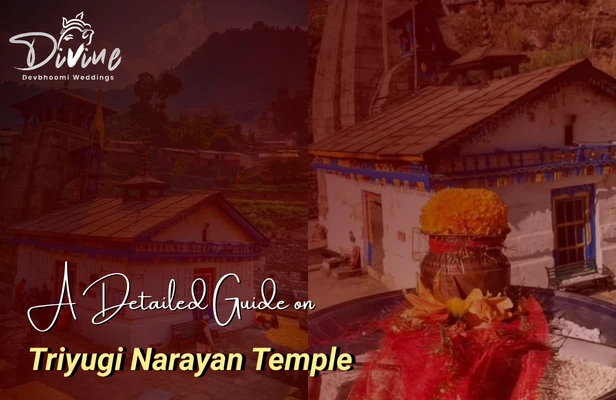
High in the Garhwal Himalayas, tucked behind Kedarnath's shadow, sits a temple where a fire has supposedly never gone out since the beginning of time. Triyugi Narayan isn't on most tourist maps the way Kedarnath or Badrinath are — and that's exactly what makes it worth the detour. This guide covers the myth, the geography, the logistics, and the small practical details that decide whether your visit goes smoothly.
Triyugi Narayan village sits at roughly 1,980 metres in the Rudraprayag district of Uttarakhand, a short distance off the main Kedarnath pilgrim route.
The name breaks down as Tri (three) + Yugi (yugas, or cosmic eras) + Narayan (Vishnu) — a reference to the belief that the sacred fire inside has burned continuously across three yugas: Satya, Treta, and Dvapara.
Locals simply call it the “Vivah Mandir” — the wedding temple — since this is held to be the exact spot where Shiva and Parvati were married. (https://devbhoomiweddings.com/)
The story begins with Sati, Shiva's first consort, who immolated herself after her father Daksha insulted Shiva. She was reborn as Parvati, daughter of Himavan (personification of the Himalayas) and Mena. Determined to win Shiva as her husband a second time, Parvati undertook years of severe penance near Gauri Kund, close to present-day Kedarnath.
Her devotion moved the gods, and the wedding that followed is said to have taken place here, at Triyugi Narayan. According to the Shiva Purana, Brahma presided as the priest, Vishnu gave Parvati away in place of her family, and the fire that was lit for the wedding rites was never extinguished afterward — it's this fire, still burning in the temple's havan-kund, that gives the site its central identity.
A carved stone slab known as the Brahma Shila is pointed out as the exact spot where the couple took their marriage vows.
The Akhand Dhuni (perpetual flame) is why most people actually make this trip. Devotees bring wood as an offering to keep it fed, and it's customary to carry a pinch of the ash home — it's believed to bless a marriage and is sometimes specifically sought out by couples trying to conceive or strengthen their bond.
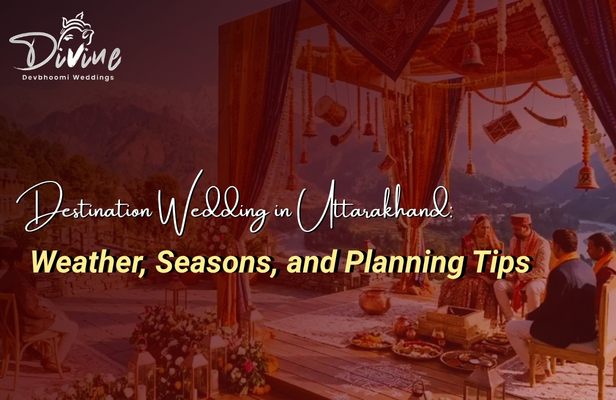
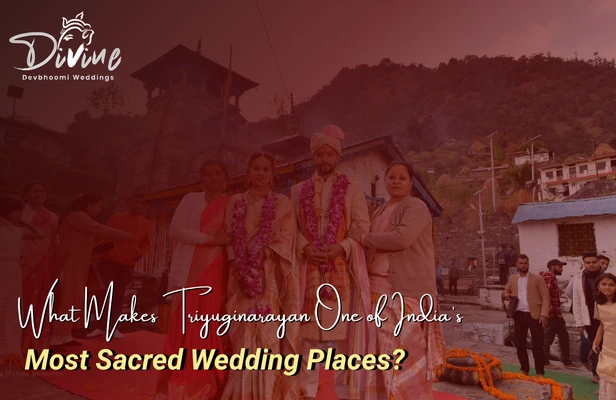
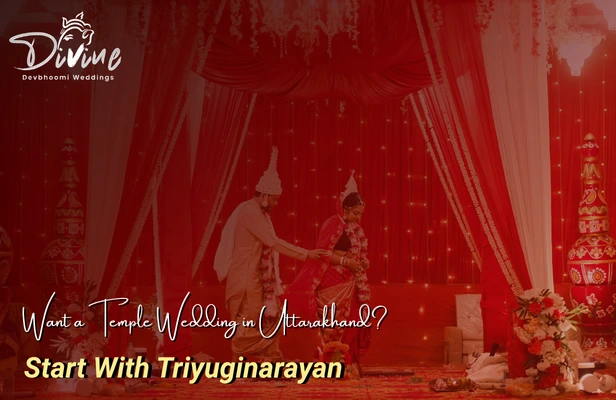
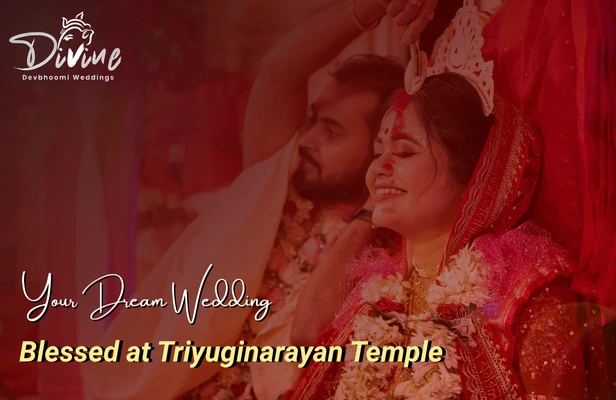
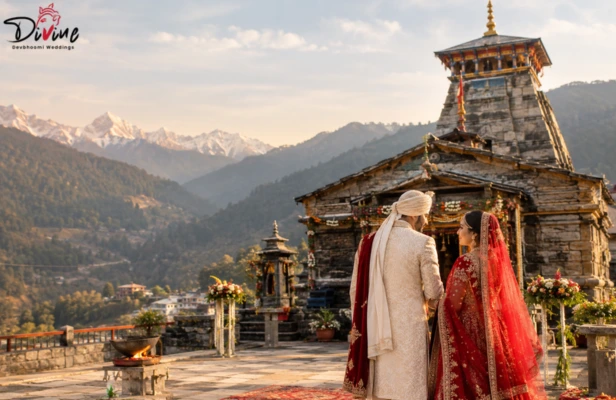
Because of this connection, Triyugi Narayan has quietly become a popular spot for intimate Himalayan destination weddings, with couples choosing to marry in front of the same fire mythology says never went out.
The temple is built in classic Garhwali style — stone walls, a wood-and-slate roof, and a modest silver-plated idol of Vishnu inside, since he is honored here as the one who officiated the union. Tradition credits Adi Shankaracharya with establishing the temple, placing it in the same lineage as several other major Himalayan shrines he's associated with.
Inside the courtyard, apart from the eternal fire and the Brahma Shila, look for old stone inscriptions and a simplicity in the structure that feels deliberately unshowy compared to bigger pilgrimage temples.
Just outside the temple are four small bathing tanks (kunds), each associated with a different blessing:
|
Kund |
Associated With |
|
Rudra Kund |
Strength and vitality |
|
Vishnu Kund |
Purification |
|
Brahma Kund |
General blessings |
|
Saraswati Kund |
Knowledge / liberation |
Pilgrims commonly take a ritual dip, especially in Rudra Kund, before entering the temple. Locals also hold that bathing here helps couples struggling with infertility, though this is a matter of faith rather than anything verifiable.
|
Activity |
Time |
|
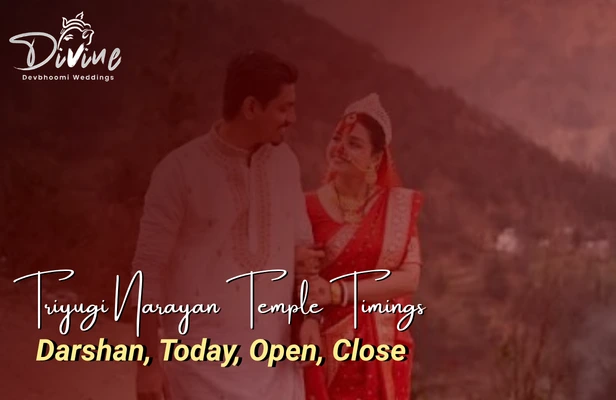
Temple opens |
4:00 AM |
|
Morning pooja |
6:00 – 7:00 AM |
|
General darshan |
Through the day |
|
Bhog (food offering) |
12:00 – 1:00 PM |
|
Evening aarti |
8:30 PM |
|
Temple closes |
7:00 PM |
Darshan is free and photography is generally allowed outside the sanctum, though drone use requires prior permission. Timings can shift slightly during the Ekadashi Mela in August, so it's worth confirming locally if you're visiting around then.
April to June — the most popular window: clear skies, 15–25°C, good mountain views.
September to November — post-monsoon, noticeably fewer crowds, still pleasant weather.
December to March — avoid if possible; snowfall regularly cuts off road access.
July to August (monsoon) — the route runs through landslide-prone hill roads; only attempt with a flexible schedule and a close eye on weather advisories.
Read More - Triyuginarayan Temple Wedding 2026 Wedding Dates Are Open! Booking, Cost & Complete Details
From Delhi, it's roughly 440–455 km, a 10–12 hour drive along the standard Kedarnath pilgrim corridor: Haridwar → Rishikesh → Devprayag → Rudraprayag → Guptkashi → Sonprayag.
This is the part most guides gloss over. From Sonprayag, Triyugi Narayan is about 7–8 km by road, driveable if you'd rather skip walking. But there's also a shorter, more scenic trek from Sitapur (a small settlement just before Sonprayag) — roughly 5 km one-way through pine forest and terraced fields, doable in about 2–2.5 hours at a comfortable pace, with a gentle-to-moderate gradient that doesn't require technical trekking experience.
If you're already in the region for the Kedarnath yatra, some travelers combine both: descending from Gaurikund toward Sonprayag and detouring to Triyugi Narayan before or after, since the two sites share the same base town.
There's no large hotel infrastructure directly at Triyugi Narayan village — expect simple guesthouses and homestays with basic rooms, geyser hot water, and home-cooked Garhwali meals. Most travelers instead base themselves in Sonprayag or Guptkashi, both of which have a wider range of hotels and better connectivity, making a day trip to the temple easy. Book ahead during the April–June season, since rooms fill up fast with Kedarnath-bound pilgrims passing through the same towns.
Given the overlap in route, most people fold Triyugi Narayan into a longer Kedarnath or Panch Kedar itinerary rather than visiting it as a standalone trip.
Is entry to Triyugi Narayan Temple free? Yes, darshan is free of charge.
Can I visit without doing the Kedarnath yatra? Yes — it's reachable independently via Sonprayag and doesn't require a Kedarnath permit or trek.
How long does the visit itself take? Most pilgrims spend 1–2 hours at the temple and kunds, longer if you're walking in from Sitapur.
Is it suitable for elderly visitors or young children? The temple itself is easy to reach by road from Sonprayag; the walking trail from Sitapur is moderate and best suited to those reasonably fit.
Triyugi Narayan doesn't try to overwhelm you the way some of Uttarakhand's bigger shrines do. It's a quiet stone courtyard, a fire that's supposedly never gone cold, and a story that's been retold at this exact spot for centuries. Whether you're here on faith, curiosity, or just breaking up a longer Kedarnath journey, it's a worthwhile stop — just plan the season, the road, and your packing list, and the rest takes care of itself.






















































































From pre-wedding celebrations to grand wedding days, we provide end-to-end services for all functions.
Copyright © 2024 | All Rights reserved by Divine Dev Bhoomi | Designed & Developed by Edtech Innovate Pvt. Ltd.