
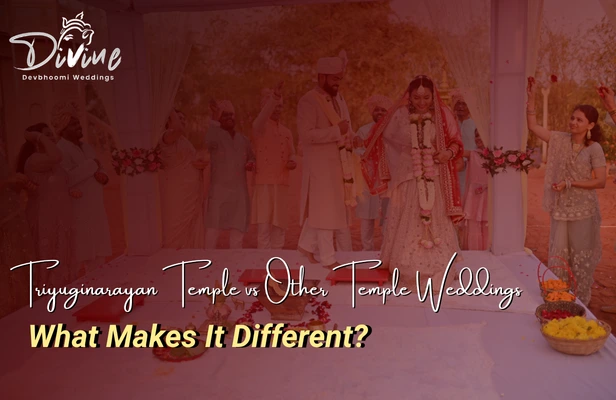
Across India, the idea of a Temple Wedding is no longer a niche preference — it has become one of the fastest-growing choices for couples who want their marriage to feel rooted in meaning rather than spectacle. Instead of banquet halls and rehearsed stage entries, more families are choosing sacred spaces where rituals carry centuries of belief behind them.
Among these destinations, Triyuginarayan Temple in Uttarakhand holds a distinct place, largely because local tradition considers it the very spot where Lord Shiva and Goddess Parvati were married in the presence of Lord Vishnu, witnessed by an eternal flame said to have burned since that day. Set in Uttarakhand — often called Devbhoomi, the Land of the Gods — Triyuginarayan combines mythology, mountains, and ritual in a way few venues can replicate.
But is it the right choice for every couple? This article compares Triyuginarayan with other well-known temple wedding destinations across spirituality, rituals, scenery, accessibility, and cost, so you can decide with clarity rather than assumption.
Weddings in India are shifting. Couples raised on elaborate five-star functions are now actively seeking ceremonies that feel personal, rooted, and less performative. A temple wedding offers exactly that — a return to ritual over routine. This shift is visible in how couples describe what they want from their big day:
This growing appetite for a Temple Wedding in India has also fuelled interest in destination formats — where the ceremony itself becomes part of a larger journey rather than a single evening event.
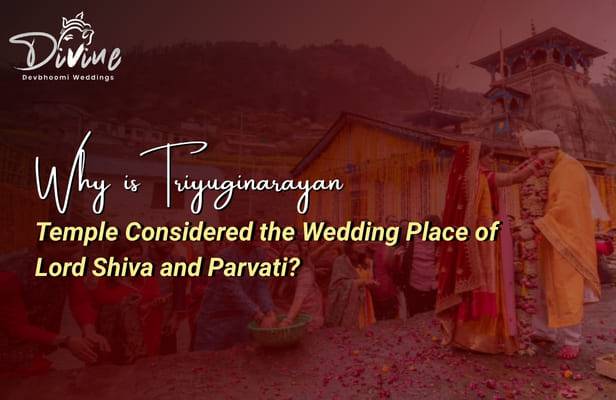
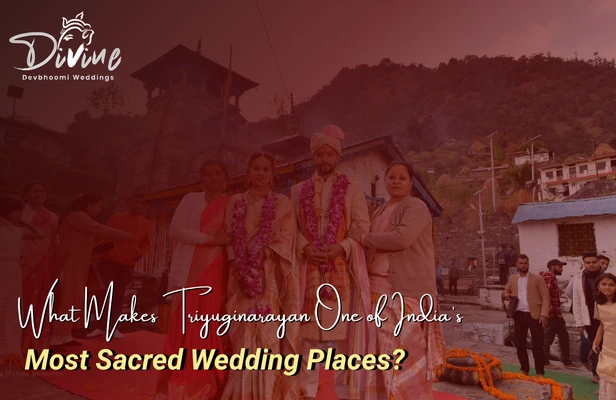
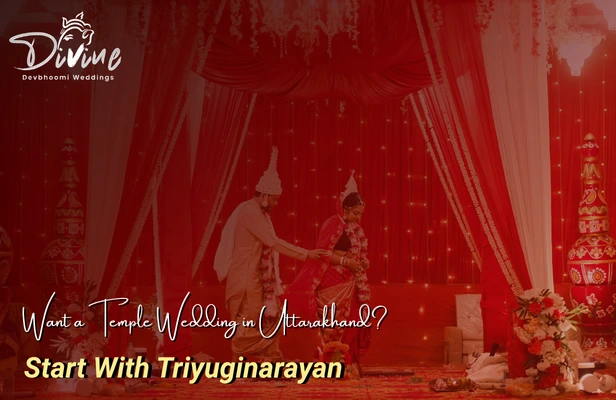
Triyuginarayan's reputation as a wedding destination isn't built on marketing — it's built on mythology that predates recorded history. According to tradition, this is where Lord Shiva and Goddess Parvati took their marriage vows, with Lord Vishnu acting as the divine witness and Lord Brahma performing the rites. The temple's most striking feature is the Akhand Dhuni, a fire believed to have burned continuously since that divine wedding, with couples today taking their own pheras around its ashes.
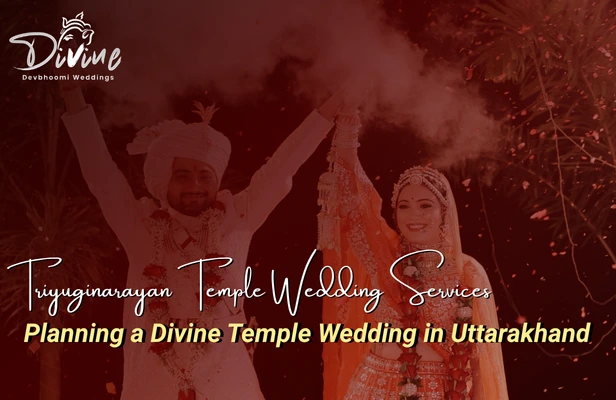
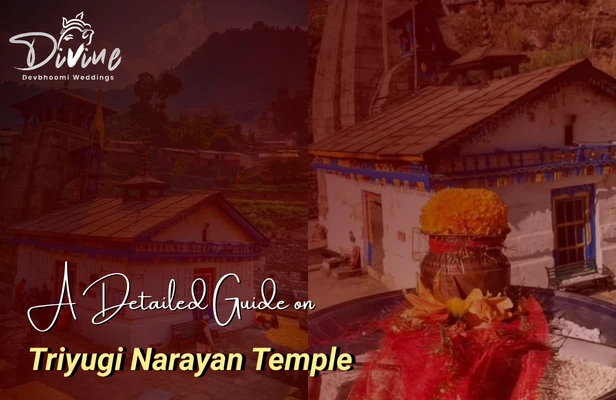
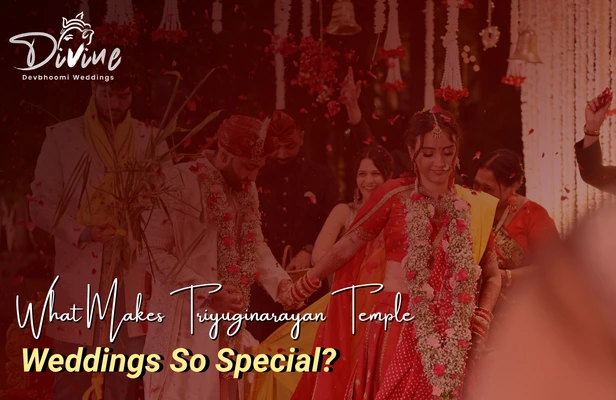
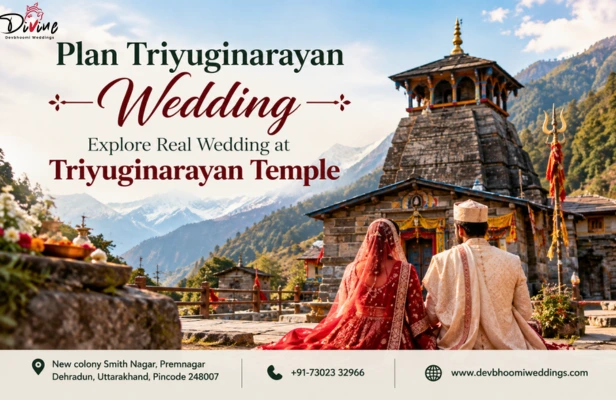
A Triyuginarayan Temple Wedding draws couples who want their ceremony connected to this exact story — not a general Hindu Temple Wedding, but one tied to a specific, named event in scripture. The temple itself is modest in scale, built in stone, and surrounded by mountains rather than manicured gardens, which gives a Triyuginarayan Wedding an atmosphere closer to pilgrimage than performance. For many families, this direct association with the Shiva Parvati Wedding Place is the single biggest reason they consider it over any other venue.
No two temple wedding destinations offer the same experience, even though they may share religious significance. The table below compares Triyuginarayan against temple wedding destinations more broadly, based on factors couples actually weigh during planning.
|
Factor |
Triyuginarayan Temple |
Other Temple Wedding Destinations |
|
Mythological significance |
Believed site of Shiva-Parvati's wedding, witnessed by Vishnu |
Usually linked to a deity's residence or legend, not a wedding event itself |
|
Spiritual atmosphere |
Quiet, remote, pilgrimage-like |
Ranges from serene to crowded, depending on popularity |
|
Wedding rituals |
Pheras around the Akhand Dhuni, Vedic rites |
Rituals vary by region and temple tradition |
|
Natural surroundings |
Himalayan forests, river valleys, mountain villages |
Often urban or semi-urban settings |
|
Himalayan backdrop |
Yes — core part of the experience |
Rare outside Himalayan-region temples |
|
Privacy |
High, due to remote location and limited footfall |
Lower at famous, high-footfall temples |
|
Guest experience |
Pilgrimage plus mountain travel |
Depends on city infrastructure and crowd levels |
|
Accessibility |
Moderate — road travel from Sonprayag/Guptkashi |
Ranges from very easy to difficult |
|
Accommodation |
Limited but improving, near Sonprayag/Guptkashi |
Wide range near well-connected temple towns |
|
Photography |
Dramatic natural light, mountain and stone visuals |
Often architecture-focused, more formal |
|
Wedding size |
Best suited to intimate gatherings |
Ranges from intimate to very large |
|
Destination experience |
Strong — wedding doubles as a Himalayan trip |
Varies; some are single-day, temple-only events |
|
Cost considerations |
Depends on guest count, season, travel logistics |
Similarly variable; urban temples may cut transport costs |
|
Overall experience |
Spiritual, intimate, nature-driven |
Often more traditional-urban or architecturally grand |
Couples drawn to Triyuginarayan tend to prioritise spirituality over scale, intimacy over grandeur, and a Himalayan setting over urban convenience. If your guest list is large, or your priority is easy access for elderly relatives, other temple destinations may serve you better — and that's a genuine trade-off worth acknowledging rather than glossing over.
South Indian temples — known for towering gopurams, elaborate Dravidian architecture, and centuries-old ritual calendars — offer a very different atmosphere from Triyuginarayan's modest stone structure. Climate is a major differentiator too: South Indian temple towns are typically warm year-round, while Triyuginarayan sits in a cooler mountain climate that shapes guest comfort and wedding attire choices. Wedding traditions in the south often involve region-specific customs, while Triyuginarayan ceremonies lean on the specific Shiva-Parvati narrative. Landscape-wise, South Indian temples are usually surrounded by temple towns and urban infrastructure, whereas Triyuginarayan is framed by forests and river valleys — a difference that shows clearly in wedding photography.
Compared to well-known North Indian temple wedding destinations, Triyuginarayan's biggest differentiator is its Himalayan setting combined with genuine remoteness. Many North Indian temple towns are well connected by rail and road, offering easier accessibility for large guest lists. Triyuginarayan, by contrast, requires a final stretch of mountain road travel, which naturally limits guest numbers but also protects the intimacy of the ceremony. Religious significance at both types of destinations can be strong, but Triyuginarayan's specific claim — being the actual wedding site of Shiva and Parvati — gives it a narrower but deeper spiritual appeal.
This is perhaps the starkest comparison. Conventional destination wedding venues — resorts, palaces, banquet lawns — are designed spaces built for flexibility: any décor theme, any guest count, any entertainment format. Triyuginarayan is the opposite: a religious ceremony, not a designed event, held in a natural setting rather than a curated one. Where resort weddings often centre on entertainment and hospitality services, a Triyuginarayan wedding centres on ritual and intimacy. Couples choosing between the two are really choosing between two different definitions of “special” — engineered luxury versus inherited sanctity.
Several elements come together to make a Triyuginarayan Temple Wedding distinct from nearly any other venue in India:
Few venues can combine ancient temple architecture, an eternal sacred fire, and Himalayan scenery within the same ceremony — which is precisely why couples researching a Spiritual Wedding Venue keep returning to this comparison.
A temple wedding places the couple inside a sacred environment shaped by centuries of ritual. Vows exchanged in such spaces carry religious blessings that many families consider essential to a marriage's foundation, alongside a stronger sense of cultural connection than a secular venue can offer.
Vedic rituals — Ganesh Puja, Sankalp, Kanyadaan, the sacred fire, and the pheras — are performed with full traditional sequencing rather than compressed for a stage schedule. Family participation in each ritual step remains central, not decorative.
Temple settings, especially remote ones like Triyuginarayan, naturally cap guest numbers. For couples who'd rather have fifty people who matter than five hundred acquaintances, this isn't a limitation — it's the appeal.
A temple wedding destination often functions as a mini-pilgrimage: guests combine the ceremony with local sightseeing, cultural exploration, and nature experiences they wouldn't get from a standard banquet hall wedding.
Mountains, alpine valleys, deodar forests, and quiet river towns give a Destination Wedding in Uttarakhand a visual character that's difficult to replicate elsewhere in India.
Uttarakhand's identity as Devbhoomi comes from its density of temples and pilgrimage routes — Kedarnath, Badrinath, Gangotri, Yamunotri, and smaller sacred sites like Triyuginarayan are all part of this landscape.
Mountain backdrops, ancient stone architecture, and natural forest light give photographers material that urban venues simply can't offer — a major reason couples researching Wedding Venues in India shortlist Uttarakhand specifically for portraits.
A Mountain Wedding Venue Uttarakhand wedding rarely stays confined to one event. Most families extend it into a multi-day trip covering the ceremony, nearby pilgrimage stops, sightseeing, and dedicated family time — turning a single-day function into a shared travel memory.
Most Hindu temple weddings follow a broadly similar ritual sequence: Ganesh Puja to remove obstacles, Sankalp as a formal vow of intent, Kanyadaan as the giving away of the bride, core Vedic rituals invoking the gods, the Pheras around sacred fire, and final blessings from the presiding priest.
What separates wedding rituals at Triyuginarayan Temple from those elsewhere is the fire itself. At most temples, the sacred fire is lit specifically for the ceremony. At Triyuginarayan, couples take their pheras around the Akhand Dhuni — a fire tradition holds has burned continuously since Shiva and Parvati's own wedding. For many couples pursuing a genuinely traditional Hindu wedding, this unbroken continuity is symbolically more powerful than a freshly kindled flame, even if the surrounding ritual steps are similar to those performed elsewhere.
Cost is one of the most-searched aspects of temple wedding planning, and it's also the hardest to pin to a fixed number — because it depends entirely on individual choices. The major factors that shape any temple wedding budget include:
|
Cost Factor |
Triyuginarayan Wedding |
Other Temple Weddings |
|
Ceremony |
Modest temple donation plus priest arrangements |
Similar, though fees vary by temple popularity |
|
Accommodation |
Limited premium options; mid-range stays nearby |
Wider range, especially in connected temple towns |
|
Catering |
Local vendors; menu options may be more limited |
Often broader vendor choice in urban locations |
|
Transportation |
Higher, due to mountain-road logistics |
Lower in easily accessible temple towns |
|
Décor |
Simpler, nature-complemented décor recommended |
Greater scope for elaborate décor at flexible venues |
|
Photography |
Premium for scenic locations, generally competitive |
Varies by city and demand |
|
Guest hospitality |
More planning needed for remote travel and altitude |
Easier in cities with established infrastructure |
|
Wedding planning |
Local expertise strongly recommended |
Depends on venue complexity |
There is no honest way to quote a fixed price for either option — your final budget will depend on your guest list, chosen season, accommodation standard, and how many functions you plan around the main ceremony. Treat any “starting price” you see online as a rough indicator, not a quote.
Triyuginarayan itself is a small village, so most families base their guests in nearby towns such as Sonprayag or Guptkashi, both a short drive away. Options typically include:
When planning accommodation, factor in distance from the temple, comfort levels for elderly guests, availability of transportation between stays and the venue, room categories that suit mixed group sizes, and clear meal arrangements — since dining options directly at the village are limited.
Pleasant temperatures, blooming mountain scenery, and comfortable travel conditions make spring one of the most photograph-friendly windows for the ceremony.
Warmer days and generally stable travel conditions make summer manageable for guest comfort, though outdoor functions should still plan for sudden weather shifts at altitude.
Post-monsoon skies typically bring clearer mountain views, making this a strong season for photography, alongside generally cooler, comfortable weather.
Monsoon months bring their own challenges — landslide-prone roads, unpredictable weather changes, and travel disruptions are common in the Himalayan region during this period. Whichever season you choose, build a weather and travel contingency plan into your itinerary rather than treating it as optional.
The nearest major airport is Jolly Grant Airport in Dehradun, from where guests continue by road — a multi-hour mountain drive, so factor this into arrival planning.
Rishikesh and Haridwar serve as the most commonly used railway gateways, both well connected to major Indian cities, with onward road travel required from there.
Road connectivity runs through Rishikesh, Haridwar, and Dehradun, with Delhi typically serving as the starting point for guests travelling from further afield. The final stretch to Triyuginarayan branches off from Sonprayag. Practical tips for guests: build extra travel time into the schedule, prefer SUVs or hill-experienced drivers for the final stretch, and avoid scheduling travel during heavy monsoon days.
Planning a wedding in a remote Himalayan location comes with logistics that differ significantly from a city-based event — road conditions, limited vendor infrastructure, temple coordination protocols, and guest travel all need local expertise to run smoothly. This is where an experienced destination wedding planner in Uttarakhand like Devbhoomi Weddings can add real value, typically coordinating:
Local knowledge matters more in a Himalayan destination wedding than almost anywhere else — from knowing which roads to avoid during monsoon to understanding temple protocols that aren't listed online. This is the practical case for working with established wedding planning services in Uttarakhand rather than coordinating everything remotely.
If your vision of a wedding leans toward smaller guest celebrations, genuine spiritual atmosphere, and natural beauty over engineered luxury, Triyuginarayan is worth serious consideration. Its traditional rituals, Himalayan experience, and emotional significance as the Shiva-Parvati wedding site create a depth of meaning that's hard to manufacture at a conventional venue. For family-focused celebrations built around authentic cultural experience rather than scale, an intimate destination wedding at Triyuginarayan offers something increasingly rare — a ceremony that feels inherited rather than designed.
Temple weddings have moved from a traditional fallback to a deliberate, meaningful choice for couples who want their marriage rooted in something larger than a single evening's event. Within that landscape, Triyuginarayan stands apart for reasons that go beyond scenery — its direct mythological link to Lord Shiva and Goddess Parvati, the continuously burning Akhand Dhuni, and its quiet Himalayan setting combine to create a genuinely distinctive Temple Wedding experience.
Compared with other temple wedding destinations, it trades scale and easy accessibility for intimacy, authenticity, and a story that few venues in India can claim. What it demands in return is careful planning — around guests, accommodation, transportation, and weather — which is where experienced local guidance becomes invaluable. Handled well, a wedding at Triyuginarayan isn't just a ceremony; it's the beginning of a marriage in a place tradition itself calls sacred.
What makes Triyuginarayan Temple different from other temple wedding venues?
Its direct mythological connection to Lord Shiva and Goddess Parvati's wedding, the continuously burning Akhand Dhuni, and its remote Himalayan setting combine to create a spiritual, intimate atmosphere that's difficult to find at more accessible or urban temple venues.
Is Triyuginarayan Temple good for a destination wedding?
Yes, for couples specifically seeking a spiritual, traditional, and intimate destination wedding. It suits smaller guest lists and families comfortable with mountain travel more than those planning large-scale celebrations.
What are the best temple wedding places in India?
There's no single “best” — it depends on priorities. South Indian temples offer grand architecture and established infrastructure; North Indian temples often provide easier accessibility; Himalayan temples like Triyuginarayan offer mythological depth and natural scenery. The right choice depends on guest count, budget, and the kind of experience you want.
Why is Triyuginarayan associated with Lord Shiva and Goddess Parvati?
Hindu tradition holds that this is the site where Shiva and Parvati were married, with Lord Vishnu as witness and Lord Brahma conducting the rites. The temple's sacred fire, the Akhand Dhuni, is believed to have burned continuously since that event.
Is a Triyuginarayan Temple wedding expensive?
Cost depends on guest count, accommodation category, transportation, catering, décor, and whether you engage a wedding planner. There's no fixed price — treat any online figure as a rough guide rather than a quote.
What rituals are performed at a Triyuginarayan Temple wedding?
Typically Ganesh Puja, Sankalp, Kanyadaan, core Vedic rites, and Pheras around the Akhand Dhuni, followed by priest blessings. Exact arrangements should always be confirmed directly with the temple priest or wedding coordinator.
Can NRI couples have a temple wedding in India?
Yes. However, the religious ceremony and legal marriage registration are separate processes. NRI couples should verify applicable legal and documentation requirements in advance, ideally with local legal guidance.
Can Mehendi, Haldi and Sangeet be organised near Triyuginarayan?
Yes, pre-wedding functions can usually be arranged at nearby accommodation in Sonprayag or Guptkashi, subject to venue availability and local regulations.
Is photography allowed during a Triyuginarayan wedding?
Photography and videography are generally permitted, but permissions and any restrictions should always be confirmed directly with temple authorities in advance.
How early should couples book a Triyuginarayan wedding?
Several months in advance is advisable, particularly for auspicious dates, peak travel seasons, and securing accommodation and transportation in a region with limited infrastructure.
Can a wedding planner arrange a complete Triyuginarayan wedding package?
Yes. An experienced planner can typically coordinate temple arrangements, accommodation, transportation, décor, catering, photography, guest hospitality, and on-the-day wedding management.





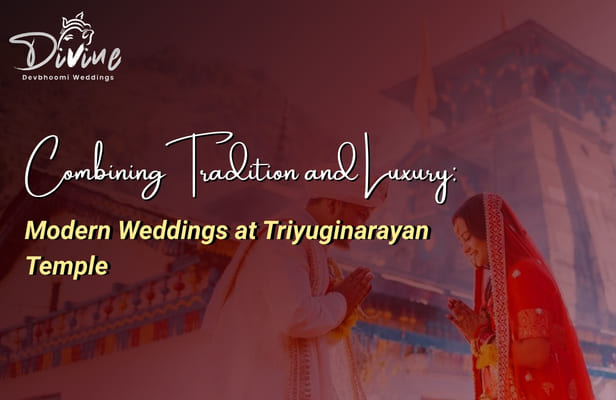

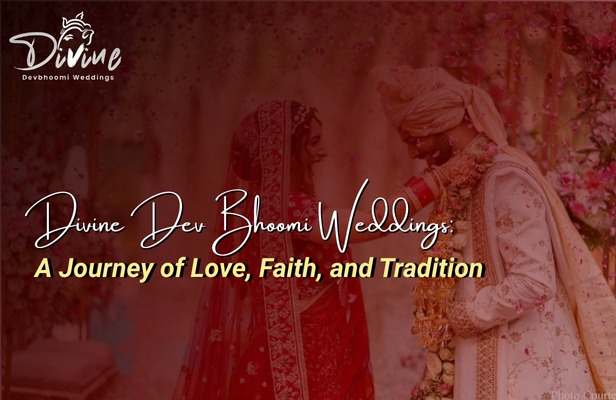

































From pre-wedding celebrations to grand wedding days, we provide end-to-end services for all functions.
Copyright © 2024 | All Rights reserved by Divine Dev Bhoomi | Designed & Developed by Edtech Innovate Pvt. Ltd.