
Every year, thousands of pilgrims, honeymooners, and destination-wedding couples set out to cover the Rishikesh to Triyuginarayan Temple distance, a journey that winds through some of the most breathtaking valleys in the Garhwal Himalayas. Triyuginarayan is believed to be the very spot where Lord Shiva and Goddess Parvati were married in the presence of Lord Vishnu and Lord Brahma, and its Akhand Dhuni, a sacred flame said to have burned continuously since that celestial wedding, draws devotees from across the world.
Uttarakhand is often called Devbhoomi, the Land of Gods, and this route through Devprayag, Srinagar, and Rudraprayag shows exactly why. Whether you are planning a spiritual pilgrimage, a temple wedding, or simply a scenic Himalayan road trip, understanding the exact distance, the best route, and realistic travel time will help you plan a smoother and safer journey. This guide covers everything you need, from road conditions and transport options to nearby attractions, accommodation, and the best season to travel.(https://devbhoomiweddings.com/)
The road distance between Rishikesh and Triyuginarayan Temple is approximately 205 to 220 km, depending on the exact route taken and whether the final Sonprayag-to-temple stretch is included. The straight-line aerial distance is considerably shorter, around 110 to 120 km, but the mountainous terrain means the actual driving distance is nearly double that figure.
Most travelers cover this distance in roughly 7 to 9 hours by private car or taxi, though this can extend during monsoon season or heavy traffic near pilgrimage towns. Triyuginarayan Temple itself sits at an altitude of around 1,980 metres (about 6,500 feet), which is why the final approach feels noticeably cooler and hillier than the lower stretches near Rishikesh.
This route is popular for three simple reasons: it is the shortest practical road link from the Rishikesh–Haridwar belt into the Kedarnath valley, it passes through well-known pilgrim towns where fuel, food, and rest stops are easy to find, and it offers some of the most scenic river-valley views in the entire Char Dham circuit.
|
Parameter |
Approximate Value |
|
Road distance (Rishikesh to Triyuginarayan) |
205–220 km |
|
Aerial (straight-line) distance |
110–120 km |
|
Average travel time by road |
7–9 hours |
|
Altitude of Triyuginarayan Temple |
~1,980 metres |
|
Last motorable stretch |
Sonprayag to temple, ~12 km |
|
Final walk to temple |
Under 1 km |
The most commonly used route follows the Rishikesh–Badrinath/Kedarnath highway corridor before branching off near Guptkashi. Here is the stage-by-stage breakdown:
The route is well signposted throughout, and fuel stations are readily available up to Guptkashi; travelers should top up here since options thin out beyond Sonprayag. Food stops are plentiful in Devprayag, Srinagar, Rudraprayag, and Guptkashi, all of which have dhabas serving simple North Indian meals. For scenery, the Devprayag confluence, the Alaknanda viewpoints near Rudraprayag, and the pine forests around Agastyamuni are the standout photo stops along the way.
Read More - Triyuginarayan Temple Wedding Packages Explained
Travel time varies noticeably depending on the mode of transport and prevailing road conditions. A private car with a single non-stop driver can complete the journey in around 7 hours in ideal conditions, while a shared cab or bus, which makes multiple stops, can take closer to 9 to 10 hours. Bike travelers should budget slightly more time to account for fatigue on the hairpin sections and cooler temperatures at higher altitude.
Weather has the single biggest impact on travel time. Monsoon rains (July–August) can trigger temporary landslide-related delays, while winter fog and occasional snowfall near Guptkashi and Sonprayag can slow the final stretch considerably. Weekend and festival-season traffic near Rudraprayag and Guptkashi, both busy pilgrim junctions for the Kedarnath route, can also add an hour or more.
|
Mode of Transport |
Approx. Travel Time |
Notes |
|
Private Car |
7–8 hours |
Fastest, most flexible option |
|
Taxi (hired) |
7–9 hours |
Comfortable, driver handles mountain roads |
|
Bike |
8–10 hours |
Scenic but tiring on hairpin stretches |
|
Bus (to Sonprayag) |
9–10 hours |
Budget-friendly, multiple stops |
|
Shared Cab |
8–9 hours |
Cost-effective, shared with other travelers |
There are several practical ways to cover this route, and the right choice depends on your budget, group size, and comfort needs.
For families, pilgrims, and wedding guests carrying luggage, a private taxi or car remains the most convenient option since it allows flexible stops, safer mountain driving, and comfortable seating for the 7–9 hour journey.
The stretch from Rishikesh to Rudraprayag largely follows a well-maintained national highway with good surfacing, wide enough for two-way traffic in most sections. Beyond Rudraprayag, the road narrows into a typical Himalayan mountain road with frequent hairpin bends, especially between Guptkashi and Sonprayag, and again on the final Sonprayag–Triyuginarayan link road.
For travelers coming from other nearby cities, here is a quick comparison of distances and estimated travel times to Triyuginarayan Temple.
|
Starting City |
Approx. Distance |
Estimated Travel Time |
|
Rishikesh |
205–220 km |
7–9 hours |
|
Haridwar |
240–250 km |
8–10 hours |
|
Dehradun |
230–250 km |
8–10 hours |
|
Delhi |
440–460 km |
12–14 hours |
|
Rudraprayag |
85–95 km |
3–4 hours |
|
Guptkashi |
40–45 km |
1.5–2 hours |
|
Sonprayag |
12 km |
30–40 minutes |
Pleasant daytime temperatures and clear mountain views make spring one of the best windows for travel. Roads are generally dry, and this period marks the start of the pilgrimage season.
Warm in the lower valleys near Rishikesh but comfortably cool near Triyuginarayan. This is peak pilgrimage and wedding season, so book accommodation and taxis well in advance.
Considered the best season overall: post-monsoon skies are clear, roads have been repaired after monsoon damage, and the valley views are at their most vivid, making this ideal for photography.
Cold, with occasional snowfall near higher stretches. Roads remain accessible most days, but early starts and cautious driving are essential; some travelers prefer this season for a quieter, less crowded pilgrimage experience.
Overall, avoid the peak monsoon weeks of July and August when landslide risk is highest; spring and autumn offer the best balance of good weather and manageable crowds.
While Triyuginarayan village itself has a limited number of guesthouses, most travelers choose to stay in the nearby, better-equipped towns and travel the short remaining distance on the day of their visit.
Nearby stay hubs worth considering include Sonprayag (closest to the temple), Guptkashi (best overall facilities and choice), and Sitapur (a quieter alternative with a handful of comfortable guesthouses).
The Rishikesh to Triyuginarayan Temple distance of roughly 205 to 220 km captures one of Uttarakhand's most rewarding spiritual journeys, winding through river confluences, pine forests, and pilgrim towns before reaching the sacred site of Shiva and Parvati's celestial wedding. While the road itself is manageable for most travelers, proper route planning, an early start, and awareness of seasonal weather patterns make all the difference between a stressful drive and a memorable one.
Whether you are undertaking this trip as a pilgrim, a tourist exploring Devbhoomi, or a couple planning a destination wedding at Triyuginarayan, a little preparation goes a long way. Fuel up in Guptkashi, pace yourself on the mountain bends, and build in time for the scenic stops along the way, and this journey will likely become one of the highlights of your Himalayan travels.
The road distance is approximately 205 to 220 km, typically covered in 7 to 9 hours depending on the mode of transport and road conditions.
Most travelers take between 7 and 9 hours by car or taxi, while buses and shared cabs can take closer to 9 to 10 hours due to additional stops.
The most popular route runs via Devprayag, Srinagar, Rudraprayag, Agastyamuni, Kund, Guptkashi, and Sonprayag, followed by the final 12 km link road to the temple.
Yes, the road is generally safe and well-used by pilgrim traffic, though caution is needed on hairpin bends beyond Rudraprayag and during monsoon or winter weather.
Yes, regular buses run from Rishikesh up to Sonprayag, after which a short taxi ride or a brief walk on the link road completes the journey to the temple.
Rishikesh railway station (Yog Nagari Rishikesh) is the nearest major railway station, located roughly 205 to 220 km from the temple by road.
Spring (March–May) and autumn (September–November) offer the most comfortable weather and clearest mountain views, while the monsoon months of July–August are best avoided.
Basic guest houses are available in Triyuginarayan village itself, while a wider range of hotels and resorts can be found in nearby Sonprayag and Guptkashi.
Yes, many pilgrims combine both, since Sonprayag serves as the common gateway town for the road to Triyuginarayan and the trek route toward Gaurikund and Kedarnath.



















































































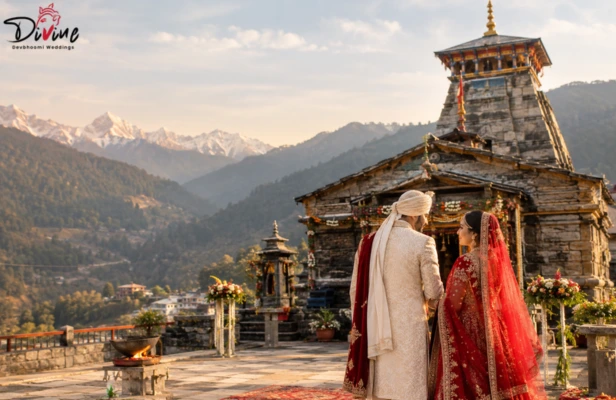


















From pre-wedding celebrations to grand wedding days, we provide end-to-end services for all functions.
Copyright © 2024 | All Rights reserved by Divine Dev Bhoomi | Designed & Developed by Edtech Innovate Pvt. Ltd.