
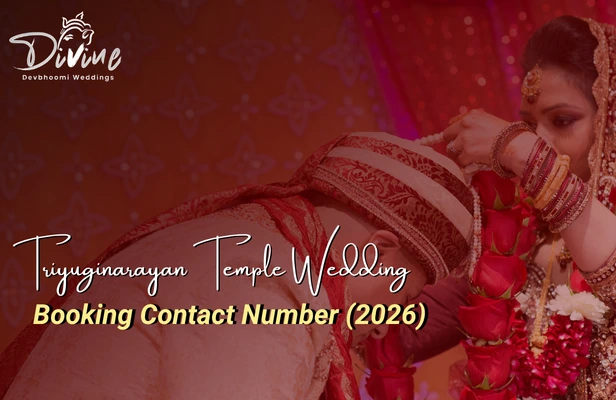
If you are searching for the Triyuginarayan Temple Wedding Booking Contact Number, the fastest way to move forward is this: reach out to a verified wedding booking and coordination number, share your preferred date and guest count, ask for a written quotation, and confirm every detail before making any advance payment. For wedding coordination and booking assistance at Triyuginarayan Temple, couples can call or WhatsApp +91-73023 32966. This is a wedding booking and coordination helpline that assists couples with date checking, package selection, documentation, and on-ground arrangements — it is not the temple committee's internal number, so always confirm final rituals, priest availability, and temple rules directly with the temple committee once your coordinator connects you. Never pay the full amount upfront, and always ask for a written confirmation of your date before transferring any advance.
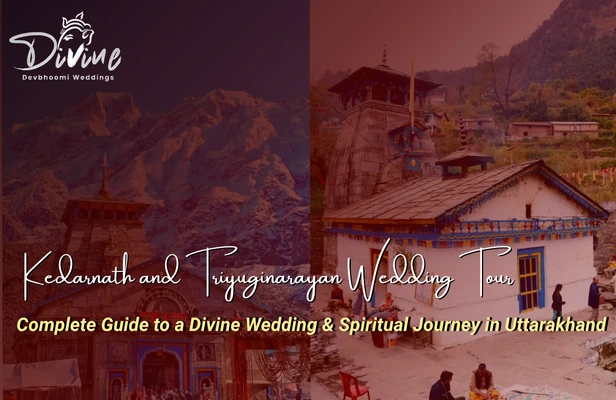
Every year, thousands of couples type the same search into Google: Triyuginarayan Temple Wedding Booking Contact Number. It is not hard to understand why. Triyuginarayan is not just another wedding venue — it is believed to be the very spot where Lord Shiva and Goddess Parvati were married, with an eternal flame, the Akhand Dhuni, still burning as a living witness to that divine union. For couples who want their own marriage to be blessed by that same energy, no five-star banquet hall can compete with this small stone temple tucked into the Garhwal Himalayas.
But sacred sentiment alone doesn't get a wedding booked. Triyuginarayan sits in a remote part of Uttarakhand — the land often called Devbhoomi, or "land of the gods" — near Sonprayag and Rudraprayag, not far from the Kedarnath route. Limited local infrastructure, a short usable wedding season, and genuine demand from families across India and abroad mean that dates fill up quickly, especially during auspicious wedding muhurats. That's exactly why booking early, and knowing exactly who to contact, matters so much.
What makes Triyuginarayan different from a typical wedding venue search is that you're not just booking a hall — you're coordinating a religious ceremony inside a heritage temple, in a Himalayan village with limited hotel rooms, patchy mobile connectivity, and roads that can be affected by weather. That combination is exactly why so many families feel unsure about where to even start. Who do you call first? Is there really an "official" booking line? Can the temple handle a full wedding party, or is outside coordination needed for things like decor, catering, and guest stay? These are the questions this guide is built to answer.
This guide walks you through the entire process — from your first enquiry call to the final phera around the Akhand Dhuni — covering contact details, the booking process, documentation, packages, costs, travel, accommodation, and the rituals themselves, so you can plan with confidence. Whether you are a Hindu family based in Delhi looking for a two-day intimate wedding, an NRI couple flying in from abroad for a once-in-a-lifetime spiritual ceremony, or a wedding planner researching this destination for a client, the sections below are organised so you can jump straight to what you need, or read through end to end for the complete picture.
Search interest around this exact phrase has grown steadily for a few clear reasons:
There's also a practical, less obvious reason this search term has grown: outdated or incorrect contact numbers circulating online. Because Triyuginarayan doesn't have a large official tourism or wedding department the way bigger destination-wedding markets do, older blog posts, forum threads, and directory listings sometimes carry contact details that are years old, no longer active, or were never verified in the first place. This is exactly why the "verify before you pay" advice repeated throughout this guide matters so much — the goal isn't just to find a number, but to find one you can actually trust.
Here is the step-by-step process most couples follow when booking a wedding at Triyuginarayan:
Calls go faster and quotations come back more accurate when you have these details ready:
| Item | Have It Ready? |
|---|---|
| Bride & groom names | ☐ |
| Preferred + backup dates | ☐ |
| Guest count estimate | ☐ |
| Budget range | ☐ |
| Accommodation preference | ☐ |
| Ritual list | ☐ |
| ID documents scanned/photographed | ☐ |
Once you make first contact, the process typically unfolds in these stages:
Most families find it useful to think of this as three broad phases rather than a rigid checklist. The first phase, roughly 3–6 months out, is about locking your date and package — this is when you should complete document verification and pay your initial advance, only after receiving written confirmation. The second phase, roughly 4–8 weeks out, is about finalising the details: guest list, accommodation blocks, catering headcount, and any pre-wedding ceremonies. The third phase, in the final 1–2 weeks, is about logistics — confirming travel plans with every guest, doing a final check-in call with your coordinator, and making sure all documents and payment records are organised and easy to access during travel.
Packages generally fall into four broad tiers. Exact inclusions vary, so always request a current, written breakdown.
| Package | Typically Includes | Best For |
|---|---|---|
| Basic | Core temple rituals, priest arrangement, minimal decor | Small, intimate ceremonies |
| Standard | Rituals + decor + basic accommodation assistance | Mid-sized family weddings |
| Premium | Rituals + enhanced decor + photography + accommodation + local transport | Couples wanting a fuller experience |
| Luxury | Full end-to-end planning, premium stay, videography, guest hospitality | Larger weddings, NRI families |
Every package can typically be customised — for instance, adding pre-wedding ceremonies, extending guest stay, or upgrading photography coverage.
When comparing packages, ask specifically about a few details that often get glossed over in verbal pitches: how many days of accommodation are actually included, whether transport from Rishikesh/Dehradun/Haridwar is part of the package or arranged separately, whether the priest's fees and puja samagri are included in the headline price or billed extra, and how many people the catering estimate is based on. Getting clarity on these four points alone usually explains most of the price difference between coordinators quoting for what looks, on paper, like the "same" package.
There is no single fixed price for a Triyuginarayan wedding — cost depends heavily on guest count, season, and how much you customise. Broadly, the following factors move the price up or down:
Because prices shift with season, fuel costs, and vendor availability, always ask your coordinator for a current, itemised quotation rather than relying on numbers you find online — treat any published figure as an estimate, not a fixed rate.
To help you budget realistically, here is how most Triyuginarayan wedding costs are typically distributed across categories. Note that these are illustrative proportions, not fixed amounts, and your coordinator's quotation should always be treated as the accurate source:
| Category | Typical Share of Budget | What Influences It |
|---|---|---|
| Accommodation | 25–30% | Number of rooms, hotel category, length of stay |
| Catering | 20–25% | Guest count, menu type, number of meals |
| Rituals & priest fees | 10–15% | Number of ceremonies, puja samagri, priest experience |
| Decoration | 10–15% | Scale, flowers used, custom themes |
| Transportation | 10–15% | Distance, vehicle type, number of trips |
| Photography/videography | 10–15% | Duration, drone use, editing package |
A few practical points worth keeping in mind while budgeting: hill-region logistics generally cost more than plains weddings of a similar size, because vendors, décor material, and even basic supplies often need to be transported from further away. Peak season dates also tend to carry a premium due to high demand. On the other hand, keeping your guest list intimate — which many couples choose to do specifically because of the spiritual, personal nature of a Triyuginarayan wedding — naturally keeps costs more manageable across every category above.
A tip that saves a lot of last-minute stress: prepare two sets of every document — one physical folder you carry with you, and one digital folder (scans or clear photos) saved in your phone and backed up to cloud storage. Given the region's patchy connectivity, having a physical copy on hand is genuinely useful, while the digital backup protects you in case anything gets misplaced during travel. If witnesses are travelling separately from the couple, make sure their documents are collected and organised ahead of time too, not on the morning of the ceremony.
Triyuginarayan is a small village, so accommodation ranges from very basic to comfortable, with most guests actually staying in nearby Sonprayag or Guptkashi and travelling in for the ceremony:
A practical tip: because Triyuginarayan itself is a small village, most wedding parties book the bulk of their rooms in Sonprayag (about 5 km away) or Guptkashi (a bit further, but with more choice), and travel to the temple only for the ceremony itself. This approach also makes it easier to accommodate larger guest lists, since a single property in the village rarely has enough rooms for a big wedding party. If you're planning for more than 20–25 guests, ask your coordinator early about block-booking a property, since availability in this region is genuinely limited compared to a plains city.
| Budget Level | Typical Option | Location |
|---|---|---|
| Budget | Dharamshala / guest house | Triyuginarayan village, Sonprayag |
| Mid-range | Standard hotel | Sonprayag, Guptkashi |
| Premium | Resort-style property | Guptkashi |
| Luxury | Higher-end hotel/resort | Rudraprayag and surrounding areas |
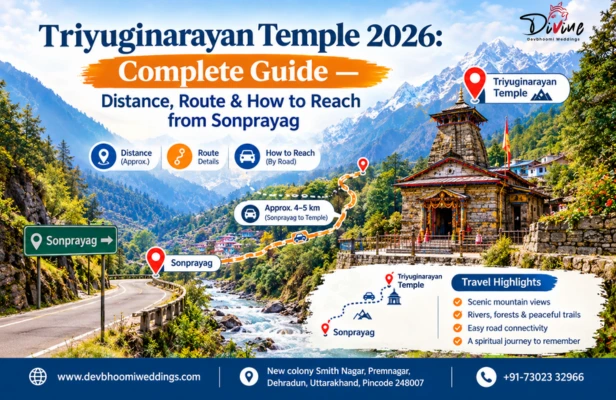
The nearest airport is Jolly Grant Airport in Dehradun, roughly 220–240 km away, connected by taxi or bus to Rudraprayag and onward to Sonprayag.
The nearest major railhead is Rishikesh, with Haridwar also serving as a common arrival point for long-distance trains, followed by a road journey through Devprayag, Rudraprayag, and Guptkashi.
Triyuginarayan is well connected by road via Rishikesh → Devprayag → Rudraprayag → Guptkashi → Sonprayag → Triyuginarayan. From Sonprayag, it's a short drive up to the temple. Major routes:
The final stretch of the journey, from Sonprayag to Triyuginarayan, is a short but steep climb, usually covered by shared jeep, private taxi, or on foot for those who prefer a short trek. Roads through this belt are well-travelled (this is also the route toward Kedarnath), but they are hill roads — narrow in places, with hairpin bends — so it's worth building extra travel time into your itinerary, especially for elderly guests or those unfamiliar with mountain travel.
The rituals performed here follow a traditional Vedic wedding ceremony structure, made unique by the setting:
What sets this ceremony apart from a typical Vedic wedding elsewhere is the setting itself. Instead of a fire lit specifically for the occasion, couples circle a flame with a documented, continuous history — the Akhand Dhuni is said to be flanked by four kunds (ponds), Rudra Kund, Vishnu Kund, Brahma Kund, and Saraswati Kund, each tied to different aspects of the wedding legend. Many couples choose to take a ritual dip or perform a small puja at Rudra Kund before the ceremony, believed to be where Lord Vishnu himself performed the kanyadaan. Priests at the temple are accustomed to guiding outside families through each of these steps, so even couples unfamiliar with the specific local traditions are walked through what to do at every stage.
Depending on your package and family preferences, you can choose to keep the ceremony to just the essential temple rituals, or extend it with a small havan and blessing ceremony the evening before, and a simple reception-style gathering for close family afterward at your accommodation.
| Season | Weather | Demand | Photography |
|---|---|---|---|
| Spring (Mar–Apr) | Pleasant, blooming valleys | High | Excellent |
| Summer (May–Jun) | Cool relief from plains heat | Very High (peak wedding season) | Very Good |
| Autumn (Sep–Oct) | Clear skies post-monsoon | High | Excellent |
| Winter (Nov–Feb) | Cold, possible snow, limited access | Low | Dramatic but logistically harder |
Note: the monsoon months (July–August) are generally avoided due to landslide risk on hill roads, and access can be restricted around this time. Always double-check current road and weather conditions with your coordinator closer to your date.
Beyond the general seasonal pattern, it also helps to think about your specific priorities. Families prioritising photography often lean toward autumn, when post-monsoon skies tend to be at their clearest and the surrounding Himalayan peaks are most visible. Families prioritising cost tend to look at the shoulder periods just before or after peak summer, when demand — and therefore pricing — is typically a bit softer, while weather is still manageable. And families with elderly guests or young children often avoid winter altogether, since cold temperatures and occasional snowfall can make travel and outdoor rituals more difficult to manage comfortably.
Because Triyuginarayan is remote and small-scale, a local wedding planner or coordinator familiar with the temple and the area brings real, practical value:
It's worth being clear-eyed about this: hiring a coordinator is not a requirement set by the temple itself, and plenty of families with local contacts or prior experience in the region manage arrangements independently. But for most outstation and NRI families, the value of a coordinator isn't the wedding ceremony itself — it's everything around it. Someone who already knows which hotel has enough rooms for your guest list, which caterer can actually deliver a large vegetarian spread in a village with limited market access, and which local transport operator is reliable during peak season saves families a significant amount of stress in the weeks leading up to the wedding.
Of these, the two mistakes that cause the most stress for families in practice are booking too late and paying without confirmation. Because Triyuginarayan has a genuinely short peak season and limited daily capacity, a delayed decision often means losing your preferred date entirely rather than just paying more for it. And because destination wedding scams do exist across India — not specific to this temple, but a broader pattern travellers should be aware of — treating any advance payment request with healthy caution, and insisting on a written confirmation first, protects your family's money and your peace of mind.
Verify contact details through the service provider's official website or verified social presence before calling.
One more tip worth calling out separately: build in a communication plan for your guests. Since mobile connectivity can be inconsistent in parts of this region, share printed itineraries, pickup times, and emergency contact numbers with every guest before the trip begins, rather than relying solely on a WhatsApp group that some guests may not be able to access reliably once they're in the hills.
Booking a wedding at Triyuginarayan Temple is as much about careful planning as it is about faith. From the moment you decide on this sacred venue, the process runs smoothly when you start early, keep your documents ready, ask the right questions, and verify every detail before paying any advance. For wedding booking and coordination assistance, you can reach out at +91-73023 32966 — but as with any destination wedding arrangement, always confirm final details directly and in writing before proceeding. What makes this journey worthwhile, beyond the logistics, is the destination itself: the ancient courtyard where, according to belief, Lord Shiva and Goddess Parvati themselves were married, their vows witnessed by a flame that has never gone out. Few places in India offer a couple that kind of beginning.
For wedding booking and coordination assistance at Triyuginarayan Temple, you can call or WhatsApp +91-73023 32966. Always confirm final ritual and temple-specific details directly with the temple committee as well.
Start by contacting a wedding coordinator, sharing your preferred dates and guest count, reviewing package options, submitting documents, and confirming your booking in writing before paying any advance.
Initial enquiries can usually be made via phone or WhatsApp, with documentation shared digitally. A fully online, self-service booking system is not standard for this temple.
For peak season dates (especially summer and spring), booking 3–6 months in advance is strongly recommended.
Yes, WhatsApp is commonly used for initial enquiries, sharing documents, and receiving quotations.
Identity proof, age proof, passport-size photographs, and witness details are typically required. NRIs also need a valid passport.
Yes, NRI couples regularly book weddings at Triyuginarayan, provided they carry a valid passport and complete the required documentation.
Guest capacity depends on the temple courtyard space and local arrangements; smaller, intimate gatherings are generally easier to accommodate than very large ones.
Yes, most coordinators allow customisation of rituals, decor, catering, and accommodation within each package tier.
Depends on the package — Basic packages often exclude accommodation, while Premium and Luxury packages typically include assistance or bundled stays.
Jolly Grant Airport in Dehradun is the nearest airport, roughly 220–240 km from Triyuginarayan.
Enquiry → date check → package discussion → document submission → written quotation → confirmation → advance payment → final confirmation.




















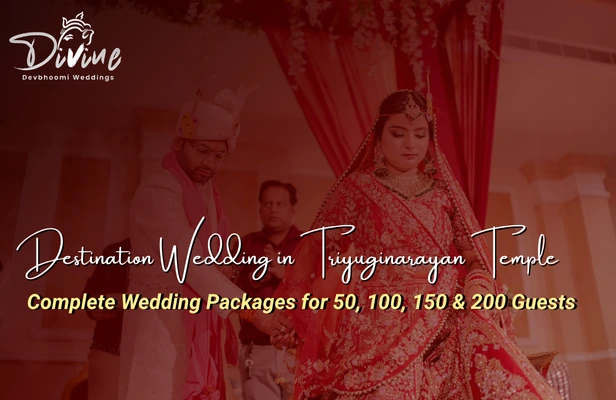





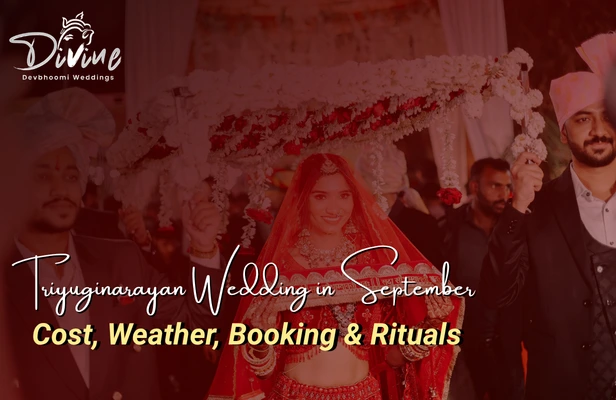


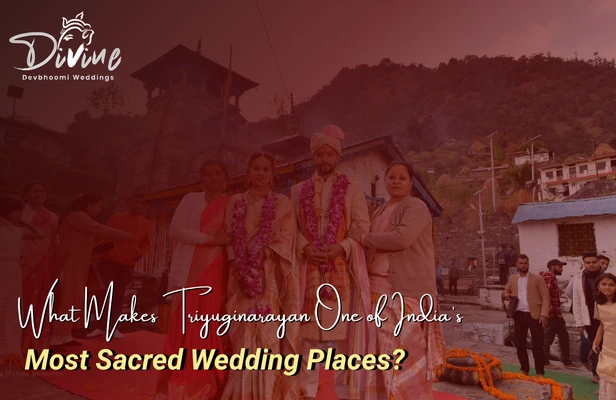


















From pre-wedding celebrations to grand wedding days, we provide end-to-end services for all functions.
Copyright © 2024 | All Rights reserved by Divine Dev Bhoomi | Designed & Developed by Edtech Innovate Pvt. Ltd.