
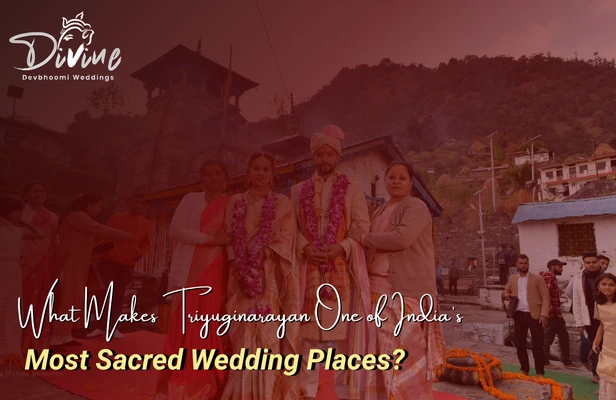
Among the many sacred wedding places in India, Triyuginarayan holds a position unlike any other. Tucked away in the Garhwal Himalayas of Uttarakhand, this ancient temple is believed to be the very site where Lord Shiva and Goddess Parvati were married, making it one of the rare destinations where mythology, faith, and matrimony converge in a single sacred space. At the heart of this belief burns the Akhand Dhuni, an eternal sacred fire said to have witnessed that divine wedding thousands of years ago and to have burned continuously ever since.
As modern couples increasingly look beyond banquet halls and hotel lawns, many are turning toward destinations that carry genuine spiritual weight. Uttarakhand, revered across Hindu tradition as Devbhoomi, the land of gods, offers exactly that kind of setting, with Triyuginarayan standing as one of its most meaningful expressions. This article explores the mythology behind the temple, the significance of its eternal flame, the rituals associated with a temple wedding here, and the practical details couples need to plan a destination wedding in Uttarakhand, from accessibility and accommodation to costs and local planning support.
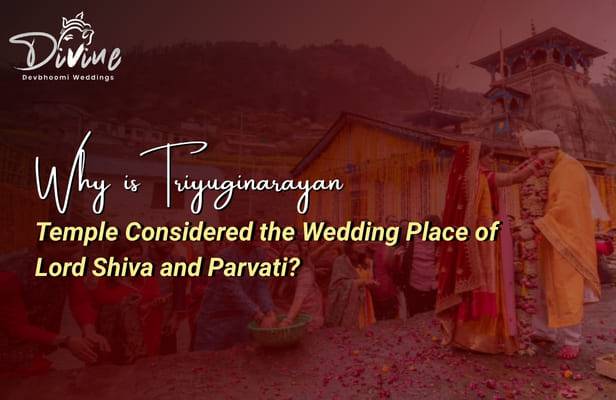
Triyuginarayan Temple is considered sacred primarily because Hindu tradition holds it as the location of the Triyuginarayan Temple wedding of Lord Shiva and Goddess Parvati, one of the most revered divine unions in Hindu mythology. According to popular belief, Lord Vishnu presided over the ceremony as the bride's brother figure, while Lord Brahma is said to have served as the priest who conducted the sacred rites. This layered involvement of three principal deities in a single ceremony is part of why the temple is treated with such reverence.
The name 'Triyuginarayan' itself refers to the belief that the wedding fire has burned across three yugas, or cosmic ages, without ever being extinguished. For devout Hindus, this continuity transforms the temple from a mere historical site into a living witness of divine commitment. The remote Himalayan location, reached only after a trek through pine forests and mountain trails, adds to the sense that this is a place set apart from ordinary life, spiritually elevated and physically demanding to reach, much like the pilgrimage traditions associated with many of India's most sacred sites.
The temple's association with the Lord Shiva and Goddess Parvati wedding place has, over generations, made it a symbol of ideal marital devotion within Hindu belief. This is a central reason couples consider it among the most meaningful Hindu wedding places in India for solemnizing their own union.
The story of Goddess Parvati's devotion to Lord Shiva is one of the most enduring narratives in Hindu mythology. Parvati is said to have undertaken intense penance and austerity to win Lord Shiva as her husband, demonstrating unwavering faith and patience. Their eventual marriage is regarded not simply as a divine event but as an ideal template for marital commitment, representing the union of shakti (energy) and shiva (consciousness), often interpreted as the balance between devotion and steadfastness within a marriage.
Triyuginarayan became associated with this sacred union through generations of oral tradition and scriptural reference, and pilgrims have long visited the temple specifically to witness or invoke the blessings of this celestial wedding. For many couples, the belief that their own vows are being exchanged at the very spot where Shiva and Parvati exchanged theirs adds a layer of spiritual meaning that a conventional venue simply cannot replicate.
|
Element |
Detail |
|
Bride |
Goddess Parvati |
|
Groom |
Lord Shiva |
|
Sacred Location |
Triyuginarayan Temple, Garhwal Himalayas, Uttarakhand |
|
Divine Witnesses |
Lord Vishnu and Lord Brahma |
|
Wedding Significance |
Considered the ideal union of devotion, patience, and marital commitment in Hindu belief |
Several distinct factors, taken together, explain why this temple continues to be regarded as one of the most sacred wedding places in India.
The temple's direct association with the wedding of Lord Shiva and Goddess Parvati sets it apart from most other pilgrimage or wedding sites in the country. Few locations in India can claim a mythological link this specific and this widely recognised within Hindu tradition.
The temple's sacred fire, believed to have burned continuously since the divine wedding, is treated by devotees as tangible proof of the ceremony's occurrence. Ash from the Akhand Dhuni is traditionally considered auspicious and is sometimes given to newlyweds as a blessing for a long and stable married life.
Located amid the pine and deodar forests of the Garhwal Himalayas, the temple's natural surroundings add a sense of serenity and elevation, both literal and spiritual, that is difficult to find in urban wedding venues.
Couples seeking a genuine Hindu temple wedding often find that the atmosphere of a working shrine, with its rituals, priests, and centuries of continuous worship, offers an authenticity that a hotel ballroom decorated to resemble a temple cannot match.
Uttarakhand's identity as Devbhoomi, or the land of gods, is reinforced by its concentration of ancient temples, pilgrimage routes, and Himalayan shrines. Getting married within this landscape is, for many families, an extension of a broader spiritual journey rather than an isolated event.
A destination wedding in Uttarakhand appeals to couples who want their celebration to feel rooted in nature, tradition, and faith, rather than in a purely commercial venue setting.
Couples can combine authentic Vedic rituals with family traditions, temple blessings, and local cultural elements such as regional music, attire, and cuisine, creating a ceremony that feels both personal and rooted in heritage.
A temple wedding typically follows a sequence of traditional Hindu rituals, though the exact ceremony and which rituals are permitted at the temple should always be confirmed directly with temple authorities and the couple's chosen priest well in advance.
Because temple rules can change and ceremonial access may be limited during certain periods, couples should always verify current permissions before finalising any part of their ceremony plan.
The Akhand Dhuni at Triyuginarayan Temple is an eternal sacred fire that, according to tradition, has burned without interruption since the wedding of Lord Shiva and Goddess Parvati. In Vedic marriage, fire, or Agni, is considered the divine witness to the marriage vows, which is why the ritual of pheras is always performed around a sacred flame.
At Triyuginarayan, this symbolism is intensified because the fire is believed to be the very same one that witnessed the original divine wedding. Taking pheras here is, for many devotees, not just a ritual reenactment but a direct spiritual continuation of that ancient union. This is a major reason the temple is distinguished from ordinary wedding venues, where a ceremonial fire is lit fresh for each wedding rather than carrying centuries of unbroken sanctity.
As a sacred wedding destination in India, Triyuginarayan brings together faith, heritage, nature, and family participation in a way few venues can replicate. The combination of ancient Hindu traditions, an intimate mountain setting, and deep spiritual symbolism makes it particularly appealing to couples who want their wedding to feel like a sacred ceremony rather than only a social celebration.
For couples planning a traditional Hindu wedding ceremony, this spiritual wedding venue offers something a hotel ballroom cannot: centuries of unbroken worship, a living mythology, and a landscape that itself feels part of the ritual.
Planning a wedding at this remote Himalayan temple requires more preparation than a conventional venue booking. The following steps outline a practical approach.
Consult family traditions and the couple's priest for an auspicious date, and check seasonal accessibility before finalising it, since mountain weather can affect travel.
Verify current temple rules directly with the temple authorities, and confirm ceremony timings and which rituals are permitted on the day.
Keep the guest count manageable given limited space and mountain logistics, and factor in the comfort of elderly guests and children.
Explore hotels, guest houses, resorts, and group stays in nearby towns such as Sonprayag and Guptkashi well ahead of the wedding date.
Arrange road transfers suited to mountain terrain, and coordinate arrival and departure schedules with adequate buffer time.
Keep decoration respectful of the temple's religious environment, using traditional floral and spiritual elements where permitted.
Plan meals according to guest preferences and the realities of local logistics in a remote mountain location.
Confirm photography and videography permissions with the temple in advance, and plan outdoor portraits around permitted locations.
|
Factor |
Triyuginarayan Temple Wedding |
Conventional Hotel Wedding |
|
Atmosphere |
Spiritual and sacred |
Luxury / social |
|
Main attraction |
Temple and mythology |
Décor and amenities |
|
Wedding style |
Traditional and intimate |
Highly customizable |
|
Setting |
Himalayan environment |
Hotel / resort setting |
|
Ritual experience |
Strong religious focus |
Depends on ceremony chosen |
|
Guest experience |
Pilgrimage + wedding |
Wedding + leisure |
|
Best suited for |
Spiritual couples |
Couples seeking conventional luxury |
Monsoon months bring a higher risk of landslides and unpredictable road conditions in this Himalayan region, which can affect both guest travel and outdoor ceremony plans. Couples considering a monsoon wedding should build in extra buffer days, monitor weather advisories closely, and always prepare a backup plan for transportation and venue arrangements.
Read More - Triyuginarayan Temple Wedding Packages Explained
The nearest major airport is Jolly Grant Airport in Dehradun, from where the temple is reached by a road journey through Rishikesh and the Garhwal hills, followed by a short trek from Sonprayag.
Haridwar and Rishikesh are the most commonly used railway stations for accessing the Garhwal region, with the remainder of the journey completed by road and a short walking trail to the temple.
Triyuginarayan is connected by road from Rishikesh, Haridwar, Dehradun, and Delhi, though the final stretch involves mountain roads and a walk from the nearest motorable point at Sonprayag.
Guest accommodation is typically arranged in nearby towns rather than at the temple itself, given its remote and limited setting.
When selecting accommodation, couples should consider distance from the temple, room availability during peak wedding season, the comfort of elderly guests, heating and weather requirements, meal arrangements, parking, and onward transportation to and from the ceremony site.
There is no single fixed cost for a Triyuginarayan Temple wedding, as the total expense depends on the number of guests, accommodation category, number of wedding functions, transportation arrangements, catering, decoration, photography, priest and ritual arrangements, hospitality requirements, and whether a wedding planner is involved. The table below outlines the main cost factors rather than a fixed price, since actual costs vary significantly by season, guest count, and service level.
|
Wedding Component |
Cost Level |
Main Cost Factors |
|
Accommodation |
Low–High |
Room category, number of nights, guest count |
|
Transportation |
Low–High |
Vehicle type, distance, number of guests |
|
Catering |
Medium–High |
Menu selection, guest count, number of meals |
|
Decoration |
Low–High |
Floral décor, mandap design, venue restrictions |
|
Photography |
Medium–High |
Team size, hours of coverage, deliverables |
|
Rituals |
Variable |
Priest fees, ceremony requirements |
|
Hospitality |
Variable |
Welcome arrangements, guest meals, services |
|
Planning |
Variable |
Scope of wedding planner involvement |
Couples are advised to request a customized quotation once they have finalized their guest count, wedding dates, and specific requirements, rather than relying on generic estimates.
The temple's remote location and limited infrastructure naturally suit smaller guest lists rather than large-scale celebrations. This works in favour of couples who prefer meaningful rituals and close family participation over an extensive social event.
An intimate format also allows families to spend more time on the actual rituals and shared experiences, such as temple visits and community meals, rather than managing the logistics of a very large gathering.
Given the logistical complexity of organising a wedding in a remote Himalayan location, many couples choose to work with an experienced local destination wedding planner in Uttarakhand rather than coordinating every detail independently.
Devbhoomi Weddings is one such local wedding-planning option with familiarity in Uttarakhand's terrain, local vendor networks, and the practical logistics of organising a wedding at a site like Triyuginarayan. Working with a planner who understands the region can reduce the uncertainty that often comes with planning a wedding far from the couple's home city.
Triyuginarayan stands apart from conventional wedding destinations because it is not simply a scenic backdrop but a site believed to carry the living memory of Lord Shiva and Goddess Parvati's own wedding. The eternal Akhand Dhuni, the Himalayan setting of Devbhoomi Uttarakhand, and the temple's unbroken tradition of worship together create a depth of meaning that few other sacred wedding places in India can offer. For couples seeking a genuinely spiritual and traditional Hindu ceremony, this destination provides an experience rooted in faith rather than only celebration.
At the same time, a wedding here requires careful planning, from confirming temple permissions to arranging travel, accommodation, and guest logistics across a remote mountain region. Working with experienced local wedding planners can make this process considerably smoother. For couples willing to plan thoughtfully, beginning married life at a place associated with one of Hinduism's most revered divine unions offers a beginning unlike any other, one carried forward on an eternal flame that has, according to belief, never gone out.
What makes Triyuginarayan one of India's most sacred wedding places?
Its mythological association with the wedding of Lord Shiva and Goddess Parvati, combined with the eternal Akhand Dhuni and its setting within Devbhoomi Uttarakhand, makes it one of the most spiritually significant wedding destinations in India.
Why is Triyuginarayan Temple famous for weddings?
The temple is famous for weddings because it is believed to be the exact site where Lord Shiva and Goddess Parvati were married, with Lord Vishnu and Lord Brahma playing key roles in the ceremony according to tradition.
Where did Lord Shiva and Goddess Parvati get married?
According to Hindu belief, Lord Shiva and Goddess Parvati were married at Triyuginarayan Temple in the Garhwal Himalayas of Uttarakhand, in front of the sacred fire that is said to still burn today.
Is Triyuginarayan Temple a good place for a Hindu wedding?
It can be an excellent choice for couples seeking a traditional, spiritually rooted Hindu wedding, though the remote location, limited infrastructure, and temple permissions mean it suits couples comfortable with careful advance planning.
What is the significance of the Akhand Dhuni at Triyuginarayan Temple?
The Akhand Dhuni is an eternal sacred fire believed to have burned continuously since the divine wedding of Shiva and Parvati, and it serves as the sacred witness for pheras performed by couples marrying at the temple.
Can couples have a destination wedding at Triyuginarayan Temple?
Yes, couples can plan a destination wedding at Triyuginarayan, though they should confirm current temple permissions, ceremony timings, and permitted rituals with the temple authorities well in advance.
What wedding rituals are performed at Triyuginarayan Temple?
Rituals commonly associated with a temple wedding include Ganesh Puja, Sankalp, Kanyadaan, Vedic mantras, pheras around the sacred fire, Sindoor and Mangalsutra rituals, and blessings from priests and family.
What is the best time for a Triyuginarayan Temple wedding?
Spring and autumn generally offer the most pleasant weather and clearer mountain views, while summer is also workable with proper planning. Monsoon months carry higher risk of road disruptions.
How can guests reach Triyuginarayan Temple from Rishikesh and Haridwar?
Guests can travel by road from Rishikesh or Haridwar toward Sonprayag, followed by a short trek to the temple, with private vehicles or tempo travellers commonly used for group travel.
How much does a Triyuginarayan Temple wedding cost?
Costs vary widely based on guest count, accommodation category, catering, décor, photography, and planner involvement. Couples should request a customized quotation once their requirements are finalized.




























































From pre-wedding celebrations to grand wedding days, we provide end-to-end services for all functions.
Copyright © 2024 | All Rights reserved by Divine Dev Bhoomi | Designed & Developed by Edtech Innovate Pvt. Ltd.