

Quick Answer: The Akhand Dhuni is a sacred fire that burns in front of Triyuginarayan Temple in Rudraprayag district, Uttarakhand. Hindu belief says it was lit at the wedding of Lord Shiva and Goddess Parvati and has never gone out since. Today, couples take their seven pheras around this flame to start married life with the same blessing.
What is the Akhand Dhuni?
"Akhand" means unbroken. "Dhuni" means a sacred fire. So Akhand Dhuni means an unbroken sacred fire. At Triyuginarayan temple, this fire burns in a havan kund (fire pit) in the courtyard, right in front of the main shrine. Because of this flame, the temple is also called the Akhand Dhuni Temple.
Devotees believe this is the very same fire that stood as a witness when Lord Shiva married Goddess Parvati. That is why it is not seen as an ordinary fire. For pilgrims it is a living symbol of a promise that never ends.
Key Facts at a glance: Location: Triyuginarayan village, Rudraprayag district, Uttarakhand, India. Also known as: Triyugi Narayan Temple, Akhand Dhuni Temple. Main deities: Lord Vishnu (Lakshmi Narayan), with Shiva and Parvati. Famous for: the eternal flame and the divine wedding site. Height: roughly 1,980 metres above sea level. Managed under: Shri Badrinath-Kedarnath Temple Committee (BKTC), as per local reports.
The name has three parts. "Tri" means three. "Yugi" comes from Yug, a long era in Hindu time. "Narayan" is Lord Vishnu. Put together, the name points to a place where Narayan has been present across three yugas, and where the sacred fire is believed to have burned through those same eras. This is the reason the village and the temple carry the same name.
The story is told in Hindu tradition and is linked to the Puranas. Here is the simple version, in order.
Parvati was the daughter of Himavan, the king of the mountains. She was born as the reborn form of Sati and was sure she wanted Shiva as her husband. Shiva, however, was deep in meditation and did not care for worldly life.
Tradition says Parvati first tried to attract Shiva by her beauty and failed. She then chose the harder path of tapasya (strict penance). Her devotion was so strong that Shiva finally agreed to marry her.
According to the Shiva Purana, as quoted on Wikipedia, Shiva proposed to Parvati at Guptkashi. The wedding itself was then held in the small village now called Triyuginarayan, near the meeting point of the Mandakini and Sone-Ganga rivers.
The ceremony took place in front of a sacred fire. Some sources say Skanda Purana places this event in the Satya Yuga. The fire that was lit that day is the Akhand Dhuni.
Lord Vishnu took the role of Parvati's brother and performed the kanyadaan (giving away the bride).
This is why the temple is dedicated to Narayan (Vishnu), even though the best-known story belongs to Shiva and Parvati.
Locals and temple priests say the fire has been burning for generations without stopping. Tradition links it to three yugas. Devotees keep feeding it with wood (samidha) offerings, so it stays alive.
Honest note: The claim that the flame has burned since the wedding is a matter of faith and tradition. It cannot be proven with history or science. What is real and visible is a fire that the temple community tends with care, every day, as a sacred duty. Respecting this belief is part of visiting the place.
The ash (vibhuti) from the Akhand Dhuni is considered holy. Many devotees believe it brings peace and happiness in married life, so couples often carry a little of it home as prasad.
A stone in front of the temple. It is believed to mark the exact spot where the wedding rituals were performed.
|
Kund |
What it is believed to be for |
|
Rudra Kund |
Used for bathing by devotees before worship |
|
Vishnu Kund |
Linked to Lord Vishnu, who gave away the bride |
|
Brahma Kund |
Linked to Lord Brahma, who performed the wedding rituals |
|
Saraswati Kund |
Believed to be the source of water for the other kunds, as per local belief |
Pilgrims also visit Gauri Kund, a temple of Parvati, which is the base for the trek to Kedarnath.
Hindu tradition does not see the wedding of Shiva and Parvati as just a love story. It is also a story about balance in the world. Here is the background, step by step.
Before Parvati, Shiva was married to Sati, the daughter of Daksha. After Sati gave up her life at her father's yajna, Shiva withdrew from the world and went into deep meditation in the Himalayas. The universe lost its balance because the great ascetic had turned away from everything.
Sati was reborn as Parvati, the daughter of Himavan and Mena. From childhood she walked the path of devotion towards Shiva. The gods also wanted this marriage, because a child born from Shiva and Parvati was needed to defeat the demon Tarakasura. That child, in tradition, is Kartikeya.
Parvati did not give up. She lived a simple life in the mountains and practised tapasya for a very long time. Shiva tested her faith, and when he saw her true devotion, he accepted. This is why many people see Parvati as a symbol of patience, strength and sincere love.
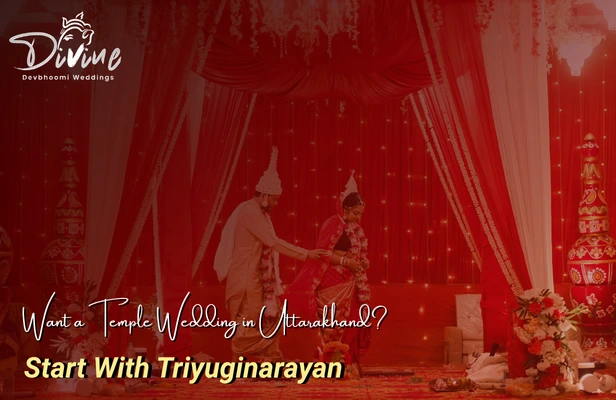
Tradition says the wedding was held at Triyuginarayan with Vishnu, Brahma, sages and celestial beings present. The fire lit that day became the witness. So the Akhand Dhuni is remembered as the first wedding fire.
Why this matters for visitors: When you stand before the Akhand Dhuni, you are standing at a place that tradition calls the origin of the Hindu marriage fire ritual. This is why even people who do not marry here come to take a moment of silence.
In Hindu weddings, the sacred fire is called Agni. It is not just for decoration. It is the main witness of the vows. The idea is simple: fire is pure, it carries offerings upwards to the gods, and it cannot be bribed or fooled. So a promise made before Agni is considered a promise made before the divine.
At Triyuginarayan, this belief gets one more layer. The fire is not a new fire lit for the day. It is the Akhand Dhuni, which is believed to link the couple's vows with the first divine wedding.
The seven pheras are the heart of the wedding. At Triyuginarayan, they are taken around the Akhand Dhuni. The exact words differ by region and family, but the seven vows are commonly explained like this:
|
Phera |
Common meaning of the vow |
|
1st |
To provide food and take care of each other's needs |
|
2nd |
To grow together in strength, health and mind |
|
3rd |
To build wealth through honest effort and share it wisely |
|
4th |
To bring happiness, respect and trust into the home |
|
5th |
To raise a caring family and care for children |
|
6th |
To stay healthy and live a long, balanced life |
|
7th |
To remain true friends for life and walk together always |
Ask your priest to explain each vow in simple words during the ceremony. Many couples say that understanding the meaning made the moment far more emotional.
You do not need to be getting married to take part in the spiritual side of the temple. Here is what many pilgrims do, with the priest's guidance.
Spiritual reason: it is believed to be the place of the first divine marriage.
Rules can change, so always confirm with the temple committee before fixing travel. This is the usual process shared by local sources in 2026.
Check the panchang (Hindu calendar) with your family priest for auspicious dates. Avoid heavy monsoon and deep winter if you want an easy journey. Keep backup dates ready.
Registration starts at the Teerth Samiti office near the temple, as per local reports. Some local planners say there is no online system and registration is done offline or through a local coordinator. Always confirm the latest rule by phone before you travel.
Couples usually give names, addresses, phone numbers and Aadhaar details. The commonly quoted registration fee is Rs 1,100. If anyone asks for much more only for "registration", ask for a receipt and check with the committee.
Once the date is free, the committee confirms the slot. Popular dates fill early. Local guides suggest booking at least 60 to 90 days ahead, and 3 to 6 months ahead for peak season.
Book hotels or homestays in Triyuginarayan, Sonprayag or Guptkashi early. Roads in the hills can be slow, so reach the village a day before the wedding.
Carry Aadhaar of both bride and groom, passport photos and ID of family members. Local reports mention 3 witnesses from each side. Parents or elders should be present.
The temple assigns its recognised priest. Reports say you generally cannot bring your own pandit, though some family customs may be allowed if they fit temple tradition. Ask about samagri (puja items) in advance.
The temple may give a receipt or ceremonial certificate. It is a religious record, and many sources clearly say it is not a legal marriage certificate.
Do this in your home state or in Uttarakhand, using the correct government process. See the next section.
Read More - How Much Does Triyuginarayan Temple Wedding Cost 2026?
Pay only against a receipt. Check the real registration fee yourself. Do not send large advance money to unknown social media pages. Prefer planners with local reviews and a visible address.
A temple ceremony is a religious event. For legal proof, you must register the marriage with the government. One recent travel source notes that Uttarakhand has used an online registration process under its Uniform Civil Code framework since January 2025. Rules differ by state and can change, so check your state portal or the local registrar before you plan.
Pro tip: Keep your temple receipt, wedding photos, invitation card and witness details. They help during legal registration. This is general information and not legal advice.
|
Mode |
Route |
|
By air |
Nearest major airport is Jolly Grant, Dehradun. From there, take a taxi towards Rudraprayag, Guptkashi and Sonprayag. |
|
By train |
Nearest railway station is Rishikesh (and Haridwar for more trains). Taxis are available from both. |
|
By road |
Drive via Rishikesh, Devprayag, Srinagar, Rudraprayag, Guptkashi and Sonprayag. Triyuginarayan is a short drive from Sonprayag, on the Kedarnath route. |
|
Local |
Taxis and shared jeeps run in the Kedarnath valley. The final stretch to the village is a hill road, so drive slowly. |
Hill travel time varies by weather and road works. Always check the latest road status before you leave.
|
Season |
Months |
What to expect |
|
Spring / early summer |
March to June |
Pleasant weather, busy yatra season. Book early. |
|
Monsoon |
July to August |
Landslide risk and road blocks. Not ideal for weddings. |
|
Autumn |
September to November |
Clear skies, great mountain views. Many couples prefer this. |
|
Winter |
December to February |
Cold, and snow is possible. Dress warm and check roads. |
Prices change with season, so treat this as a rough planning guide only.
|
Item |
Rough cost |
Notes |
|
Temple registration |
Rs 1,100 |
As quoted by local sources. Confirm locally. |
|
Priest and puja items |
Varies |
Ask the committee for the fixed list |
|
Stay (small group) |
Rs 1,500 to 6,000 per room per night |
Depends on hotel and season |
|
Transport |
Varies |
Taxi cost depends on distance from Dehradun or Rishikesh |
|
Food and decoration |
Varies |
Keep it simple and sattvic |
|
Photographer |
Varies |
Check permission with the temple |
The temple fixes the exact slot, so treat this as a sample. Ask your priest for the final timing.
|
Time (approx.) |
What happens |
|
5:00 - 6:00 AM |
Wake up, bath, get ready in traditional dress |
|
6:30 AM |
Reach the temple, meet the priest, keep documents and puja items ready |
|
7:00 AM |
Entry to the temple area, Ganesh puja and sankalp |
|
7:30 - 9:00 AM |
Main wedding rituals, kanyadaan, vows and seven pheras around the Akhand Dhuni |
|
9:00 - 9:30 AM |
Blessings of elders, prasad, family photos |
|
10:00 AM |
Receipt or ceremonial certificate collection |
|
Rest of day |
Breakfast, rest, local sightseeing or a quiet family meal |
Ceremony length is often around 1.5 to 2 hours, as per local planners. Morning slots usually have the best light and the calmest weather.
|
Category |
What to carry |
|
Wedding items |
Wedding outfits, dupatta or stole, simple jewellery, flowers, small gifts for the priest if you wish |
|
Documents |
Aadhaar, age proof, photos, receipt copies, witness IDs, hotel booking proof |
|
Weather |
Woollen jacket, thermals, raincoat or umbrella, comfortable shoes with grip |
|
Health |
Regular medicines, ORS, pain relief, motion-sickness tablets, sanitiser |
|
Tech |
Power bank, charger, offline maps downloaded |
|
Extra |
Reusable water bottle, small cloth bag for prasad, some cash in small notes |
Start early from Rishikesh or Haridwar. Take breaks, because hill roads are slow. Reach Guptkashi, Sonprayag or Triyuginarayan by evening. Check in, rest and meet your priest or planner.
Do the wedding or main puja in the morning. Spend the afternoon at the Akhand Dhuni, Brahma Shila and the four kunds. Have a light meal and keep the evening free for rest.
Visit Guptkashi's temples or Sonprayag in the morning. If you have extra time, add a Kedarnath yatra plan in the proper season. Start the return journey after lunch.
|
Place |
Why visit |
|
Guptkashi |
A temple town with the Vishwanath temple. Tradition says Shiva proposed to Parvati near here. |
|
Sonprayag |
A river confluence on the Kedarnath route, close to Triyuginarayan. |
|
Gauri Kund |
A shrine of Parvati. It is the base point of the Kedarnath trek. |
|
Kedarnath |
One of the twelve Jyotirlingas. Open mostly from spring to around Diwali, depending on weather. |
|
Ukhimath |
Winter seat of Kedarnath when the main temple is closed. |
|
Chopta and Tungnath |
Beautiful meadows and the highest Shiva temple in the world, as commonly stated. |
|
Deoria Tal |
A lake with mountain views, reached by a short trek from Sari village. |
|
Kalimath |
A Shakti peeth and a quiet temple in the valley. |
Always check the latest yatra rules, registration and weather for Kedarnath before planning any trek or darshan.
Explore More - Combining Tradition and Luxury: Modern Weddings at Triyuginarayan Temple
Triyuginarayan is a small village. You will find simple homestays, guesthouses and a few hotels in nearby towns like Guptkashi and Sonprayag. Do not expect big banquet halls or luxury resorts right next to the temple.
Ask the priest and committee before shooting inside the temple area.
|
Mistake |
How to avoid it |
|
Booking the date only through social media pages |
Confirm with the temple committee and keep a receipt |
|
Ignoring the legal registration |
Plan government registration before or after the wedding |
|
Choosing monsoon dates |
Check weather and road status. Pick safer months |
|
Taking too many guests |
Keep the guest list small and book stay early |
|
Arriving on the wedding morning |
Reach one day earlier to avoid delay and stress |
|
Forgetting documents or copies |
Make a checklist and carry extra photocopies |
|
Overpaying for "registration" |
Ask for the official receipt and compare with the committee |
|
Myth |
Fact |
|
Anyone can marry here without any permission. |
Permission and slot from the temple committee are needed. |
|
The temple certificate is your legal marriage certificate. |
It is a religious record. Legal registration is separate. |
|
You can bring any pandit you like. |
Reports say the temple assigns its own priest. |
|
The flame is proven scientifically to be thousands of years old. |
It is a matter of faith and tradition, not scientific proof. |
|
The temple is only for weddings. |
It is also a pilgrimage stop for Kedarnath yatris. |
It is a sacred eternal fire in front of Triyuginarayan temple. Devotees believe it was lit during the wedding of Lord Shiva and Goddess Parvati and has been burning ever since.
It is famous as the place where Shiva and Parvati are believed to have married. The Akhand Dhuni, the Brahma Shila and the four kunds make it a major pilgrimage and wedding destination.
Tri means three, Yugi relates to Yug (era) and Narayan is Vishnu. It points to a place linked with Narayan across three yugas.
Tradition and temple priests say it has burned continuously since the divine wedding. This is a belief of faith and cannot be proven historically. The fire is kept alive daily by offerings of wood.
Choose a date, contact the Teerth Samiti or temple committee, submit details and pay the registration fee (commonly quoted as Rs 1,100), confirm the slot, and arrive with Aadhaar, photos and witnesses. The temple priest then performs the rituals and the seven pheras around the Akhand Dhuni.
Aadhaar of both partners, age proof, address proof, passport photos and witness IDs. Divorce or death certificates are needed in some cases. Always confirm the current list with the committee.
The ceremony is religious. For legal validity, you must register your marriage with the government as per your state rules. Keep the temple receipt and photos for the process.
The temple registration is commonly quoted at Rs 1,100. Your total cost depends on stay, travel, priest items, food and guests. A small family wedding can be kept far cheaper than a city wedding.
Book at least 60 to 90 days ahead. For peak months and popular dates, plan 3 to 6 months ahead.
March to June and September to November are the best months. Avoid July and August because of heavy rain, and be careful in winter because of cold and snow.
|
Word |
Meaning |
|
Akhand |
Unbroken, continuous |
|
Dhuni |
Sacred fire |
|
Yug / Yuga |
A long era in Hindu time cycle |
|
Kund |
A sacred pond or fire pit |
|
Kanyadaan |
Giving away the bride in a Hindu wedding |
|
Saptapadi |
The seven steps or pheras and vows |
|
Vibhuti |
Holy ash, used as prasad |
|
Samidha |
Sacred wood offered to the fire |
|
Panchang |
Hindu calendar used to find auspicious dates |
|
Tapasya |
Strict spiritual practice or penance |
Final words
The Akhand Dhuni is more than a fire. For believers, it is a reminder that a marriage is a promise made before the divine and kept through time. Whether you come as a couple planning your wedding, a family on the Kedarnath route, or a curious traveller, Triyuginarayan offers something rare: a quiet mountain village where an old story still feels alive.
If you found this guide useful, share it with someone planning a temple wedding and keep it handy for your 2026 trip. Always confirm dates, fees and rules with the temple committee before you travel.








































From pre-wedding celebrations to grand wedding days, we provide end-to-end services for all functions.
Copyright © 2024 | All Rights reserved by Divine Dev Bhoomi | Designed & Developed by Edtech Innovate Pvt. Ltd.