

A Triyuginarayan destination wedding is fast becoming one of the most sought-after choices for couples who want a wedding that feels sacred, personal, and refreshingly affordable. As modern couples move away from oversized, expense-heavy celebrations, more of them are choosing intimate destination weddings that carry genuine meaning rather than just grandeur. Nestled in the mountains of Uttarakhand, Triyuginarayan Temple is believed to be the very place where Lord Shiva and Goddess Parvati were married in the presence of Lord Vishnu himself, witnessed by an eternal flame that is said to have burned continuously for thousands of years.
Uttarakhand is often called Devbhoomi, the Land of Gods, and few places embody that title as fully as Triyuginarayan. Surrounded by pine forests, snow-capped peaks, and the sound of the Mandakini flowing nearby, the temple offers a rare combination of spirituality, natural beauty, and budget-friendly wedding planning that is hard to find anywhere else in India. Couples who marry here are not just booking a venue; they are stepping into a living legend.
This guide walks you through everything you need to know before planning your Triyuginarayan destination wedding, including detailed costs, wedding packages, rituals, travel routes, accommodation choices, the best season to marry, and practical tips to keep your celebration both meaningful and affordable.
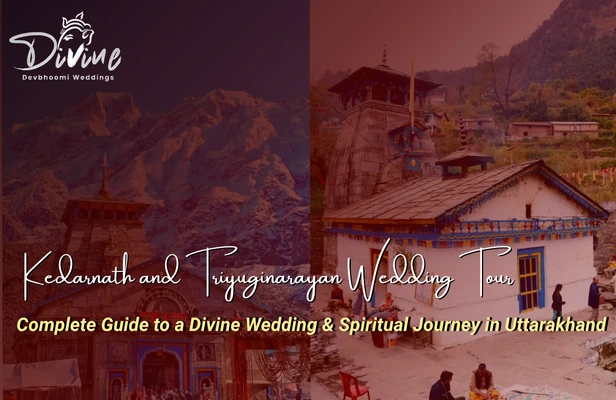
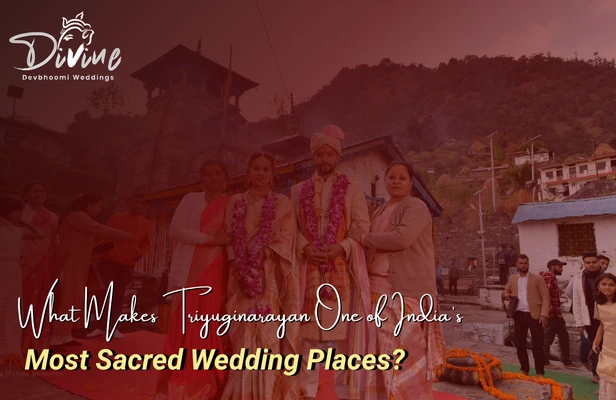
Triyuginarayan Temple sits at an altitude of around 1,980 metres in the Rudraprayag district of Uttarakhand, roughly 12 kilometres from Sonprayag. Its name literally translates to 'the place where Narayan was witness across three yugas,' referring to the belief that Lord Vishnu presided over the wedding of Shiva and Parvati at this very spot. According to legend, King Himavan, Parvati's father, performed the wedding rituals here, and the ceremony was blessed by all the gods.
At the heart of the temple courtyard burns the Akhand Dhuni, an eternal fire that devotees believe has never been extinguished since the divine wedding took place. Couples getting married at Triyuginarayan today take their pheras around this very fire, connecting their own union to a mythological event that predates recorded history. This unbroken flame is one of the most compelling reasons a Triyuginarayan destination wedding feels unlike any other wedding experience in India.
Because the temple is a modest hill shrine rather than a commercial event venue, the cost of hosting a wedding here is dramatically lower than at luxury resorts, palaces, or beach properties. There are no venue rental fees running into lakhs, no mandatory catering minimums, and no inflated 'destination markup' that couples often pay at glamorous but generic locations. This is precisely why thousands of couples, including many NRI and inter-state families, choose Triyuginarayan every year: it offers a rare mix of deep religious sanctity and genuine affordability that larger commercial venues simply cannot match.
Most Indian destination weddings today follow a fairly predictable formula: a resort ballroom, rented décor, a fixed catering menu, and a schedule dictated by the venue rather than the couple. A Triyuginarayan destination wedding breaks that pattern entirely. Because the ceremony takes place at an actual pilgrimage site with centuries of religious history behind it, the experience carries a weight and authenticity that no manufactured 'theme wedding' can replicate.
Every element of a wedding at Triyuginarayan feels intentional rather than staged. The Himalayan backdrop of deodar and pine forests, the centuries-old stone architecture of the temple, and the quiet mountain air create an atmosphere that luxury hotels try to imitate but rarely achieve authentically. Because the temple town is small, ceremonies here are naturally intimate, usually attended by close family and friends rather than hundreds of guests, which keeps both the emotional experience and the budget in check.
Vedic rituals performed here follow the same structure believed to have been used at the original divine wedding, giving couples a sense of continuity with tradition that is difficult to replicate at a generic wedding lawn. Many couples describe the experience as less like attending an event and more like participating in something timeless.
Popular destination wedding hubs like Goa, Udaipur, Jaipur, and Mussoorie are beautiful, but they come with a price tag that puts them out of reach for many couples. Resort rentals, mandatory in-house catering, high-season surcharges, and vendor exclusivity clauses can quickly push these weddings well beyond ₹10–40 lakh, even before decoration or photography is factored in.
A Triyuginarayan destination wedding, by comparison, starts at a fraction of that cost while offering something these commercial hubs cannot: direct mythological significance. Couples are not paying for a manufactured 'royal' theme; they are marrying at a place genuinely tied to one of Hinduism's most sacred love stories. The venue is also far less crowded during most of the year, meaning couples get a calmer, more personal experience instead of competing for attention with multiple simultaneous weddings at the same resort.
|
Factor |
Triyuginarayan |
Goa |
Udaipur / Jaipur |
Mussoorie |
|
Average Budget |
₹1L – ₹4.7L |
₹8L – ₹25L+ |
₹10L – ₹40L+ |
₹5L – ₹15L |
|
Spiritual Significance |
Very High (mythological) |
Low |
Moderate (palace heritage) |
Low |
|
Crowd & Privacy |
Intimate, low crowd |
Very crowded (peak season) |
Crowded, touristy |
Moderately crowded |
|
Scenic Value |
Himalayan valley views |
Beaches |
Palaces, lakes |
Hill-station views |
|
Value for Money |
Excellent |
Moderate |
Low (luxury pricing) |
Moderate |
Planning a wedding in a Himalayan temple town is different from booking a city banquet hall. Here is a step-by-step process to help you plan smoothly:
The total cost of a Triyuginarayan wedding depends on several factors, including guest count, choice of accommodation, decoration level, photography requirements, transportation needs, catering style, and any additional ceremonies such as Haldi, Mehendi, or Sangeet. Because the base venue costs are naturally low, couples have far more flexibility to allocate their budget toward the experiences that matter most to them, whether that is premium photography or upgraded hospitality for guests.
Below is a comparison of the most commonly chosen Triyuginarayan wedding packages:
|
Wedding Package |
Starting Price |
Best For |
Includes |
|
Forever Beginnings |
₹105,000 |
Simple Temple Wedding |
Temple ceremony, priest arrangements, basic floral décor, wedding coordination |
|
Golden Vows |
₹158,000 |
Small Family Destination Wedding |
Premium décor, temple rituals, photography assistance, guest coordination |
|
Timeless Elegance |
₹468,000 |
Luxury Destination Wedding |
Premium décor, photography & videography, accommodation assistance, hospitality management, transportation coordination, complete wedding planning |
Note: Wedding packages can be customized according to guest count, decoration preferences, accommodation requirements, and additional ceremonies.
The rituals performed at Triyuginarayan closely mirror traditional North Indian Hindu wedding customs, but with the added significance of taking place at the mythological site of Shiva and Parvati's own marriage. Local priests are well-versed in the temple's specific customs and can guide couples through each stage of the ceremony, ensuring nothing is rushed or overlooked despite the intimate, low-key setting.
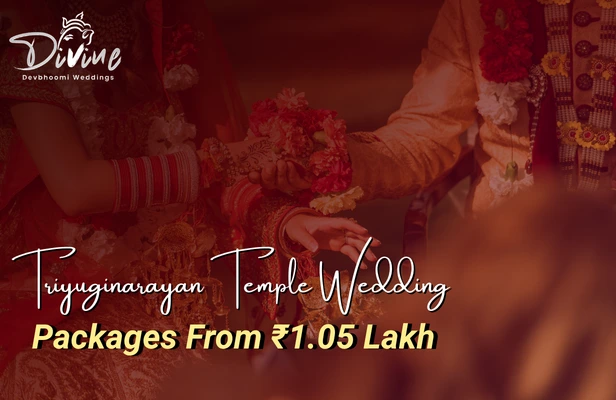
A Triyuginarayan Temple wedding typically follows a sequence of traditional Hindu rituals, each carrying its own spiritual meaning:
While Triyuginarayan itself is a small temple town, nearby areas such as Sonprayag, Guptkashi, and Sitapur offer a range of accommodation suited to different budgets and guest sizes.
When planning accommodation, consider guest comfort, ease of group bookings, availability of basic wedding hospitality services, and distance from the temple itself, since narrow mountain roads mean shorter distances are always preferable for elderly guests and children.
For larger weddings, it often works best to block a single property for the core family and use two or three nearby options for extended guests, rather than scattering everyone across many small locations. A good local wedding planner can negotiate group rates, arrange shuttle transport between properties and the temple, and ensure the entire guest list arrives and settles in without confusion — something that matters even more in a hill destination where mobile signal and last-minute coordination can be unreliable.
Spring brings pleasant weather, blooming rhododendrons, and clear mountain views, making it one of the most popular seasons for weddings. Roads are generally accessible, and photography conditions are excellent.
Early summer offers cool temperatures compared to the plains, though the monsoon typically arrives by mid-to-late June, which can affect travel plans and should be considered when finalizing dates.
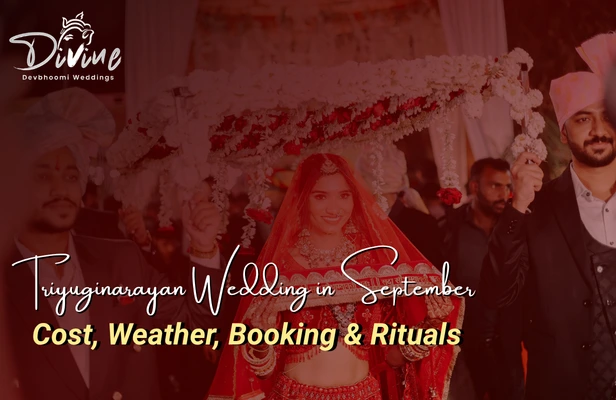
Autumn is widely considered the best season for a Triyuginarayan wedding, with crisp, clear skies, minimal rainfall, excellent road accessibility, and some of the most stunning photography conditions of the year. Crowd levels remain low even during this popular window, preserving the venue's intimate charm.
The nearest airport is Jolly Grant Airport in Dehradun, roughly 200 kilometres away. From there, guests can continue by road via Rishikesh and Rudraprayag to reach Sonprayag, the last major town before Triyuginarayan.
Rishikesh and Haridwar are the closest major railway stations, well connected to Delhi and other major cities. From either station, the temple is reached by a scenic road journey through the Garhwal Himalayas.
Road connectivity is the most common way to reach Triyuginarayan for both guests and wedding vendors.
Travel tip: Book vehicles with drivers experienced in Himalayan hill roads, plan travel during daylight hours, and build in buffer time for weather-related delays, especially during monsoon and early winter months.
Planning a wedding in a remote Himalayan temple town comes with logistical challenges that most couples have never dealt with before, from temple permissions to mountain transportation. Devbhoomi Weddings specializes in managing these details so couples can focus on the ceremony itself rather than the logistics behind it.
Their services typically include temple booking assistance, coordination of wedding permissions, accommodation management for guests of varying budgets, transportation arrangements suited to hill roads, decoration tailored to the temple's traditional setting, arrangement of qualified priests familiar with local rituals, on-ground hospitality support, photography and videography coordination, and catering suited to guest preferences. Their local expertise in the Rudraprayag region means fewer surprises and smoother execution, which matters greatly in a location where mobile connectivity and vendor availability can be limited. For couples who want a complete, end-to-end wedding planning experience without having to coordinate dozens of vendors themselves, working with an experienced local planner makes the entire process considerably easier.
Following even a handful of these tips can meaningfully reduce your total spend without diminishing the quality or sanctity of the ceremony itself. Because Triyuginarayan is inherently a modest, spiritual setting rather than a commercial event space, the biggest cost variables are almost entirely within the couple's control — which is exactly what makes it such a reliable budget-friendly choice.
A Triyuginarayan destination wedding offers something increasingly rare in modern celebrations: genuine spiritual meaning combined with real affordability. From the eternal Akhand Dhuni to the Himalayan backdrop, every element of a wedding here connects couples to one of Hinduism's most sacred love stories, without the inflated costs typically associated with destination weddings in Goa, Udaipur, Jaipur, or Mussoorie.
With flexible packages starting at ₹105,000 and scaling up to fully managed luxury experiences at ₹468,000, couples across budgets can find a package suited to their needs. Add to this the temple's natural beauty, intimate atmosphere, and rich ritual tradition, and it becomes clear why so many couples consider it one of India's best budget wedding venues.
Working with experienced local planners like Devbhoomi Weddings can make the entire process, from temple booking to guest hospitality, considerably smoother. If you are dreaming of a wedding that feels both sacred and stress-free, it may be time to start planning your own Triyuginarayan destination wedding.
Is Triyuginarayan Temple the best budget destination wedding venue in India?
For couples seeking spiritual significance combined with affordability, Triyuginarayan is widely regarded as one of the best budget destination wedding venues in India, with packages starting at ₹105,000.
How much does a Triyuginarayan Temple wedding cost?
Costs typically range from ₹105,000 for a simple temple wedding to ₹468,000 for a fully managed luxury experience, depending on guest count, décor, and services included.
What is included in the Forever Beginnings package?
This package includes the temple ceremony, priest arrangements, basic floral décor, and wedding coordination, starting at ₹105,000.
What is included in the Golden Vows package?
This package includes premium décor, temple rituals, photography assistance, and guest coordination, starting at ₹158,000.
What is included in the Timeless Elegance package?
This premium package includes décor, photography and videography, accommodation assistance, hospitality management, transportation coordination, and complete wedding planning, starting at ₹468,000.
Can packages be customized?
Yes, all wedding packages can be customized based on guest count, decoration preferences, accommodation requirements, and additional ceremonies.
How do I book a Triyuginarayan Temple wedding?
You can book by contacting an experienced local wedding planner such as Devbhoomi Weddings, who will coordinate temple availability, permissions, and your chosen package.
What documents are required?
Couples typically need valid identity proof, age proof, and any documentation required for Hindu marriage registration, which local planners can guide you through.
Can NRI couples get married at Triyuginarayan Temple?
Yes, NRI couples regularly choose Triyuginarayan for its spiritual significance, and local planners can assist with additional documentation and logistics for overseas guests.
Is photography allowed inside the temple?
Photography is generally permitted for wedding ceremonies, though it is best to confirm specific guidelines with the temple committee or your wedding planner in advance.
Are Haldi, Mehendi, and Sangeet ceremonies available?
Yes, pre-wedding ceremonies such as Haldi, Mehendi, and Sangeet can be arranged as part of most wedding packages.
How far is Triyuginarayan Temple from Rishikesh?
Triyuginarayan is approximately 200–210 kilometres from Rishikesh, typically a scenic road journey of around 7–8 hours.
What is the best season for a Triyuginarayan wedding?
Autumn, from September to November, is considered the best season due to clear skies, minimal rainfall, and excellent road accessibility, though spring is also a popular choice.
How early should I book my wedding date?
It is advisable to book at least three to six months in advance, especially for peak season dates in spring and autumn, to secure both the temple and preferred accommodation.













































From pre-wedding celebrations to grand wedding days, we provide end-to-end services for all functions.
Copyright © 2024 | All Rights reserved by Divine Dev Bhoomi | Designed & Developed by Edtech Innovate Pvt. Ltd.