
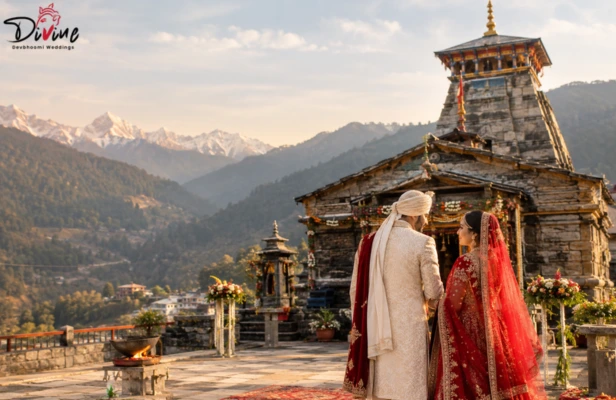
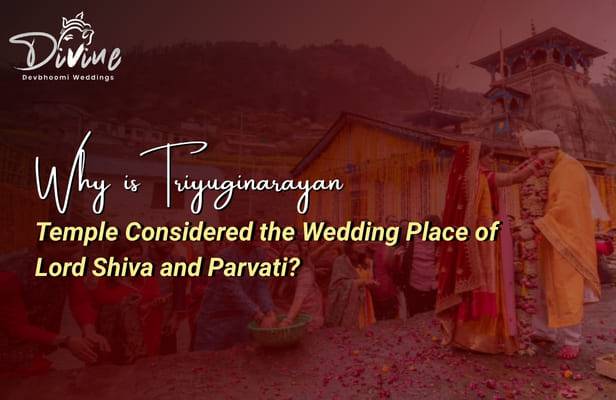
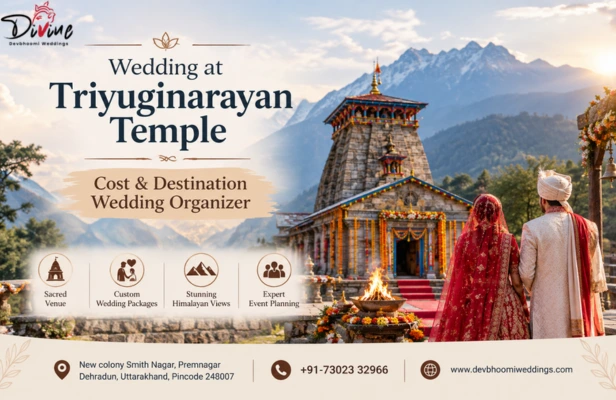
Imagine saying your wedding vows in front of a holy fire that, as the old stories say, has been burning since Lord Shiva and Goddess Parvati married there. Behind you are snow peaks. Around you is cool mountain air and the sound of temple bells. This is a Triyuginarayan temple wedding. It is quiet, sacred and deeply personal, and it costs far less than a big city wedding.
But this kind of wedding is not like booking a banquet hall. It is a working temple in a remote Himalayan village. There are rules, limited slots, document checks and weather to think about. If you plan it well, it will be the most peaceful wedding you can imagine. If you plan it badly, you may face a cancelled date, a scam, or a legal headache later..
|
Quick Answer: What is a Triyuginarayan temple wedding? A Triyuginarayan temple wedding is a Hindu Vedic marriage ceremony held at the ancient Triyuginarayan Temple in Rudraprayag district, Uttarakhand, around the sacred Akhand Dhuni (eternal fire). Couples first register with the Tirtha Purohit Samiti (the official registration fee is around ₹1,100), get a date, and marry with a temple-assigned priest. A simple ceremony usually costs ₹50,000 to ₹1.5 lakh. A wedding with 15 to 30 guests usually costs ₹1.5 to ₹3 lakh. Book 3 to 6 months ahead, and also register the marriage legally with the government. |
Why couples choose Triyuginarayan
More and more couples are moving away from loud, expensive weddings. In 2026, small and meaningful weddings are a clear trend, and a Himalayan temple wedding fits that trend perfectly. Here is why Triyuginarayan stands out.
The name “Triyuginarayan” comes from three words: tri (three), yug (age or era) and Narayan (Lord Vishnu). The name points to the belief that the sacred fire here has been burning through three yugas.
According to the legend, Goddess Parvati was born as the daughter of Himavan, the king of the mountains. She did hard penance to win Lord Shiva as her husband. The marriage was held at this village. Lord Vishnu is said to have taken the role of Parvati’s brother and performed the rituals of the wedding. Lord Brahma is said to have served as the priest.
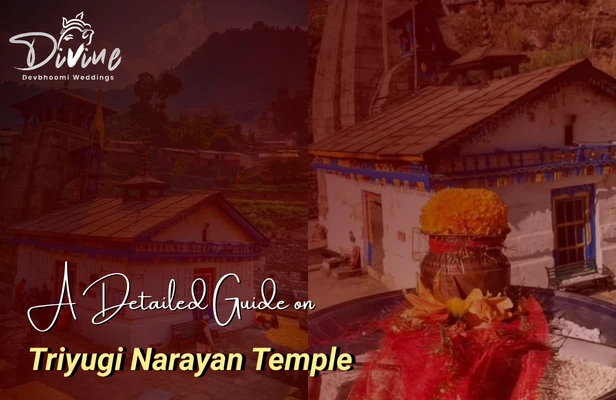
Four things at the temple are important for visitors to know:
Tip for your blog readers and guests: when someone asks “why here?”, you can tell this story in two minutes. It makes the day feel richer for everyone.
This is the most important question, and many couples get it wrong. The short answer: the temple ceremony is a religious ceremony. It does not automatically give you a government marriage certificate. You must register your marriage separately under the law.
Why it matters: you will need a marriage certificate for visas, joint bank accounts, insurance, name change, passport and property matters. Do not skip it.
Note: This section is general information, not legal advice. Please confirm with a lawyer or the registrar.
Religion: The temple performs Hindu Vedic ceremonies. Couples from other faiths or inter-faith couples should confirm with the Tirtha Purohit Samiti before planning. They can still complete a legal registration separately.
Because rules can change by season and by temple committee decision, treat this list as a guide and confirm every point in writing when you book.
Read More - Combining Tradition and Luxury: Modern Weddings at Triyuginarayan Temple
Keep both original documents and 3 to 4 photocopies of each. Mountain areas have weak internet and few print shops, so print everything before you leave.
|
Document |
Details |
|
Identity proof |
Aadhaar card of bride and groom (passport or voter ID can also work for the registrar). Overseas couples should carry passports and visas. |
|
Age proof |
10th marksheet, birth certificate or passport. Used to prove 18+ and 21+. |
|
Address proof |
Aadhaar, electricity bill or passport. Needed for legal registration. |
|
Passport-size photos |
4 to 6 of each partner. Take more; they are always needed. |
|
Wedding invitation card |
Simple printed card or digital copy. The registrar often asks for it. |
|
Witnesses |
Two adult witnesses with ID proof (three for some registrars). |
|
Divorce decree or death certificate |
Only if either partner was married before. |
|
Temple registration receipt |
From the Tirtha Purohit Samiti, after your date is confirmed. |
|
Priest certificate |
Collected after the wedding. Helpful for post-wedding registration. |
Fix your rough dates. Choose 2 or 3 possible months and check the panchang (Hindu calendar) with your family pandit. Not every day is a wedding muhurat.
Pro tip: Always keep a backup date. Landslides, snow or road closures can happen even in good months.
Costs differ a lot from one source to another. Some pages quote a very low temple-only cost, while others quote premium packages. The honest answer is that there is no single fixed price. It depends on guest count, hotel quality, travel distance, decoration, photography and how many days you stay. Below is a realistic range based on what local planners and travel companies are publishing for 2026. Always get a written quote.
|
Item |
Estimated cost (₹) |
What it covers |
|
Tirtha Purohit Samiti registration |
1,100 (official) |
Registration of your wedding date |
|
Temple donation / permission / pandal |
5,000 – 15,000 |
Customary offering and temple area use |
|
Priest (pandit) fee |
3,000 – 10,000 (higher for extended rituals) |
Conducting the Vedic ceremony |
|
Havan samagri and puja items |
2,000 – 10,000 |
Fire ritual materials |
|
Simple mandap setup |
7,000 – 10,000 |
Basic temple-friendly mandap and flowers |
|
Some planners’ all-in ritual package |
30,000 – 51,000 |
Temple, priest, samagri and mandap together |
B. Complete wedding budgets by guest count
|
Type of wedding |
Typical total (₹) |
Good for |
|
Spiritual elopement (couple + 10 to 15 guests) |
50,000 – 1.5 lakh |
Temple ceremony, one meal, basic photos |
|
Close family wedding (15 to 30 guests) |
1.5 – 3 lakh |
Ceremony, 2 to 3 nights stay, food, photographer |
|
Full destination wedding (30 to 50+ guests) |
4 – 8+ lakh |
Decor, multi-day events, reception or retreat, video |
|
Premium celebration (50 to 100 guests) |
Up to 8.5 lakh or more |
Luxury stay, designer decor, cinematic films |
C. Where the money usually goes
Money-saving tips: Choose weekdays and shoulder months, limit guests to people you truly need, ask for a bundled package that includes stay and food, and carry your own outfits and basic decor items from home.
Note: These are estimates from public 2026 listings and may change. Confirm the exact amount in writing with the temple office and your planner.
Explore More - How to Get Married at Triyuginarayan Temple
|
Month |
Weather |
What to know |
|
January – February |
Very cold, snow possible |
Beautiful but difficult. Some roads may close. Best only for hardy couples with flexible plans. |
|
March – April |
Cool and pleasant |
Excellent. Clear skies, rhododendron in bloom, fewer crowds than summer. |
|
May – June |
Warm days, cool nights |
Peak tourist and Char Dham season. Heavy traffic, high hotel prices. Book 3 to 6 months ahead. |
|
July – August |
Heavy monsoon |
Landslides and road blockages are common. Not recommended. |
|
September – October |
Fresh, clear, green |
Very good. Post-monsoon views are superb, but dates fill quickly. |
|
November – December |
Cold, crisp |
Lovely for a peaceful wedding. Pack warm clothes. Several local planners call November to April the most comfortable window. |
Hindu weddings follow auspicious dates. In 2026, some periods are traditionally avoided for weddings, such as Adhik Maas (mid-May to mid-June) and the Chaturmas period (roughly late July to Dev Uthani Ekadashi in November). Wedding dates usually resume after Dev Uthani Ekadashi, which falls around 20 November in 2026. These dates differ by panchang and by family tradition, so please confirm with your pandit before you finalise anything.
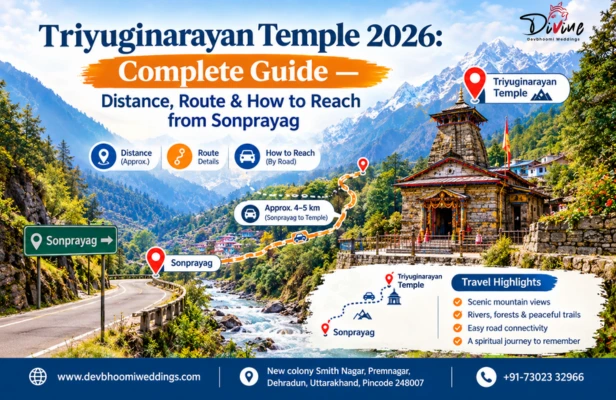
Triyuginarayan is in Rudraprayag district, Uttarakhand, on the Kedarnath route side. It is reachable by road all year, but the last stretch is a hill road, so plan extra time.
|
By |
Details |
|
Air |
Nearest airport is Jolly Grant Airport, Dehradun, roughly 250 to 270 km away. Book a cab from the airport (about 8 to 10 hours). |
|
Train |
Rishikesh and Haridwar are the nearest major railway stations, around 230 to 260 km away. Many couples start the road journey from here. |
|
Road |
From Rishikesh, follow the Rishikesh – Devprayag – Srinagar – Rudraprayag – Agastmuni – Guptkashi route, then continue towards Sonprayag and Triyuginarayan. Most planners arrange a tempo traveller or SUVs. |
|
Last stretch |
The final part is a hill road from the Sonprayag / Guptkashi side. Ask your driver and hotel about the exact current road condition. |
Plan to travel in daylight only. Start early from Rishikesh or Haridwar. Do not plan a same-day arrival and wedding. Reach one day before so everyone is rested.
Triyuginarayan village itself has limited and basic stay options. Most wedding groups stay in nearby towns and drive to the temple on the wedding morning.
Food: The temple area follows strict vegetarian rules. Expect simple and tasty meals like dal, rice, sabzi, roti, kadhi, aloo ke gutke, jhangora kheer, mandua roti and chai. If you have a larger group, ask your planner for a local caterer. Always keep a few packaged snacks and water for elders and children.
Exact rituals depend on the priest and your family traditions, but a Triyuginarayan wedding usually looks like this:
Most ceremonies take around 2 to 4 hours. Ask the priest in advance which rituals he will include, and how long each will take.
|
When |
What to do |
|
6 months before |
Choose dates with your pandit, set a budget, contact the Tirtha Purohit Samiti or trusted planner, finalise guest list. |
|
4 to 5 months before |
Pay registration, get written date confirmation, book stay and transport. |
|
3 months before |
Book photographer, makeup artist and caterer. Order outfits. |
|
2 months before |
Share travel plan and rules with guests. Start collecting documents. Apply for legal registration slot if registering first. |
|
1 month before |
Print all documents (3 to 4 sets). Plan a medical kit. Confirm every booking. |
|
2 weeks before |
Check weather and road status. Reconfirm with temple office, priest and hotel. |
|
2 to 3 days before |
Leave from Rishikesh or Haridwar. Reach the base town one day before the wedding. |
|
After the wedding |
Collect priest certificate and photos. Complete legal registration within the required time. |
Thinking the temple wedding is legally enough. It is not. Register your marriage.
Documents (originals plus photocopies), passport photos and cash. ATMs and UPI can fail in remote places.
Health: The village is at about 1,980 metres. That is not extreme altitude, but elders and people with heart or breathing problems should ask their doctor first. Drink water, avoid very heavy meals on arrival day and rest well.
|
Day |
Plan |
|
Day 1 |
Travel from Haridwar or Rishikesh towards Rudraprayag. Overnight at Rudraprayag or Agastmuni. Early dinner and rest. |
|
Day 2 |
Drive to Guptkashi. Check in. Haldi and mehendi in a relaxed family setting at the hotel. Light dinner. |
|
Day 3 (Wedding day) |
Early morning drive to Triyuginarayan. Ceremony around the Akhand Dhuni. Photos in the village. Return for lunch and rest. Evening blessing and small celebration. |
|
Day 4 |
Optional: Visit Kedarnath side points or local temples, such as Kalimath or Chopta, if time and weather allow. Complete post-wedding documents with the priest. |
|
Day 5 |
Return to Rishikesh or Haridwar. If you have not done so, plan your legal registration. |
Where is the Triyuginarayan temple?
It is in Rudraprayag district, Uttarakhand, India, in the Garhwal Himalaya.
Why is Triyuginarayan famous for weddings?
It is believed to be the place where Lord Shiva and Goddess Parvati were married, with the eternal fire as witness.
How much does a wedding at Triyuginarayan cost?
A basic ceremony costs about ₹50,000 to ₹1.5 lakh. A family wedding costs about ₹1.5 to ₹3 lakh.
What is the registration fee?
The commonly stated official registration fee is ₹1,100.
How early should I book?
Three to six months in advance, especially for May, June, September and October.
Is the wedding legal?
Not automatically. You must register under the Hindu Marriage Act or Special Marriage Act.
Which month is best?
March, April, September, October and November are the most comfortable.
A simple ceremony with 10 to 15 people usually costs ₹50,000 to ₹1.5 lakh. A wedding with 15 to 30 guests, including stay and food, usually costs ₹1.5 to ₹3 lakh. Larger destination-style weddings can cost ₹4 to ₹8 lakh or more. The temple costs themselves (registration, donation, priest, havan and mandap) are only a small part of the total. Stay, transport, food and photography make up most of the budget.
The ceremony is a valid religious wedding, but it does not by itself give you a government marriage certificate. You must register the marriage under the Hindu Marriage Act, 1955 or the Special Marriage Act, 1954, and follow Uttarakhand’s current registration rules. You can register before travelling or after the ceremony using the priest’s certificate, wedding photos and ID proofs.
Contact the Tirtha Purohit Samiti office near the temple, or use a trusted local planner connected with them. Share your names, preferred dates, guest count and ID proofs, pay the registration fee (commonly stated as ₹1,100), and get the date confirmed in writing. Then book your stay and travel.
Book at least 3 months ahead for normal months, and 5 to 6 months ahead for peak periods such as May–June and September–October. Last-minute dates are not guaranteed because the temple has limited daily slots.
You need ID proof (Aadhaar or passport) and age proof of both partners, address proof, passport-size photos, an invitation card, two witnesses with ID, and the temple registration receipt. Divorced or widowed partners must also carry a divorce decree or death certificate. Carry originals and photocopies.
March–April and September–November are the most comfortable. May–June is beautiful but crowded and expensive. July–August has heavy rain and landslide risk, and January–February can be very cold with snow. Always check the muhurat with your pandit too.
Most weddings here have 10 to 50 guests, and many couples keep it under 30. The temple area is small, so the exact limit can depend on the date and temple guidelines. Confirm the guest cap when you book.
The temple conducts Hindu Vedic rituals through its priests. Couples from other faiths or inter-faith couples should ask the Tirtha Purohit Samiti in advance whether they can take part. Legally, inter-faith couples can register under the Special Marriage Act.
The priest is usually assigned by the temple, though some custom rituals may be allowed if they follow tradition. Personal photographers and videographers are generally allowed, but drones are not permitted in temple premises. Decor should be simple and eco-friendly. Always confirm in writing.
Fly to Jolly Grant Airport (Dehradun) or take a train to Rishikesh or Haridwar, then travel by road through Rudraprayag and Guptkashi. The journey takes about 8 to 10 hours. Most wedding groups stay in Guptkashi, Sonprayag, Phata or Ukhimath and drive to the temple on the wedding day. Reach one day early.
A Triyuginarayan temple wedding is not just a cheaper way to get married. It is a way to begin married life with a clear heart, in a place that many believe holds the blessings of Shiva and Parvati. When you plan with patience, keep your guest list small, confirm every detail in writing and complete the legal registration, the day becomes smooth and unforgettable.
To recap: pick a muhurat date, register with the Tirtha Purohit Samiti, keep your documents ready, book 3 to 6 months ahead, choose the right season, and complete your government registration. That is all you need.
|
Ready to plan your Himalayan wedding? Save this guide, share it with your family, and start with one simple step today: ask your pandit for 3 auspicious dates. Then contact the temple committee or a trusted local planner to check availability. |
Disclaimer: Costs, fees, rules and dates are based on publicly available 2026 information and may change. Please confirm all details with the Tirtha Purohit Samiti, your priest, and a legal professional before you book. This guide is for general information only.











































From pre-wedding celebrations to grand wedding days, we provide end-to-end services for all functions.
Copyright © 2024 | All Rights reserved by Divine Dev Bhoomi | Designed & Developed by Edtech Innovate Pvt. Ltd.